The Best Kids' Headphones for Travel
A volume cap limits how loud the headphones can go. Isolation decides how loud a child wants them. On an aircraft, the second number is doing more of the work than anyone admits.
We have not tested this gear. Every figure here is compiled from published manufacturer specifications and published airline policies, and the arithmetic is public so you can check it. This page contains affiliate links — see the affiliate disclosure.
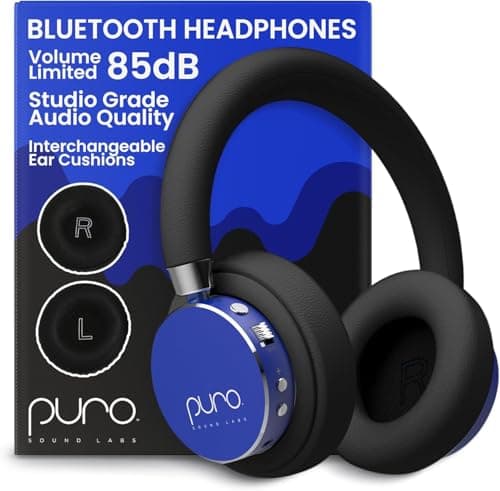
The Puro Sound Labs BT2200-Plus — the only pair here that publishes both halves of the answer: a hard 85 dB volume limit and 83% of ambient noise blocked at 1 kHz, with a 3.5 mm cable for the seatback. The JLab JBuddies Studio 2 publishes 65+ hours and a warranty twice as long — and a 95 dB setting a child can find.
Manufacturer-published figures read 11 September 2026. We have not tested these headphones and make no claim about hearing safety beyond what the makers publish.
| # | Product | Published warranty | Fits | Score | Price |
|---|---|---|---|---|---|
| 1 | Puro Sound Labs BT2200-Plus Kids HeadphonesChildren on long flights, where cabin noise tempts them to turn it up | 1 yr | Not published | 0.2 | $99.00 · Check on Amazon#ad How we earn |
| 2 | JLab JBuddies Studio 2 Wireless Kids HeadphonesMulti-leg trips where nobody wants to charge anything | 2 yr | Not published | 0.5 | $20.99 · Check on Amazon#ad How we earn |
| 3 | Sony WH-1000XM5 Noise-Cancelling HeadphonesLong-haul flights where you would rather not carry a charger for the headphones | Not published | Not published | 0.0 | $214.43 · Check on Amazon#ad How we earn |
Prices last verified October 26, 2026. Prices move — the figure you see on Amazon at the moment you click is the real one.
Two numbers, and the second matters more on a plane
Every kids’ headphone is sold on its volume cap, and the cap is real: it limits how loud the headphones can physically get. What it does not do is change how loud a child wants them.
An aircraft cabin is a loud, constant background. A child listening to a film over engine noise turns the volume up until the dialogue is clear — and on a capped pair that means sitting at the cap for hours. Isolation, the share of outside noise the ear cups block, is what lowers the volume a child needs in the first place. It is the less-marketed of the two numbers and the more useful one at 35,000 ft.
The published numbers
| Published volume limit | Published isolation | Battery | Wired mode | Warranty | |
|---|---|---|---|---|---|
| Puro BT2200-Plus | 85 dB | 83% at 1 kHz | 20 hours | 3.5 mm cable included | 1 year |
| JLab JBuddies Studio 2 Wireless | 85 dB or 95 dB setting | Not published | 65+ hours | Wired and wireless modes | 2 years |
| Sony WH-1000XM5 (adult) | None published | Active noise cancelling | 30 hours, NC on | Not in our compiled figures | Not published |
The 95 dB setting, in plain arithmetic
JLab publishes two Volume Safe settings: 85 dB and 95 dB. The decibel scale is logarithmic — every 10 dB step is ten times the sound intensity. So the higher setting is not a little louder; it is an order of magnitude more sound energy reaching the ear.
JLab positions it for louder environments, and a plane is exactly that. We would still set it to 85 dB and leave it there, and we would check it after the child has had the headphones for five minutes — because a switch on a child’s headphone is a switch a child finds.
Wired mode is not optional on a plane
Seatback entertainment is still a 3.5 mm headphone socket on almost every aircraft. A pair that is wireless-only cannot plug in, and a child who cannot hear the seatback film is a long flight for everyone in the row.
- Puro publishes an included 3.5 mm audio cable.
- JLab publishes wired and wireless modes.
- Or keep them wireless and use an adapter that turns the seatback jack into Bluetooth — one model publishes pairing for two headphones at once, which is useful with siblings. Airplane Bluetooth adapters.
Battery: 20 hours against 65
Puro publishes 20 hours; JLab publishes 65+. On a single long-haul flight either is enough. On a trip with several flights and no reliable way to charge in between, the JLab figure means the headphones are one fewer thing to plug in at every hotel. The other dependencies to remove before a flight.
In wired mode, of course, neither needs a battery at all for the seatback. That is the quiet advantage of a pair that does both.
Why not just use an adult pair?
Because an adult headphone is built to go as loud as an adult wants, and Sony, like most adult brands, publishes no child volume cap. It is also sized for an adult head, so on a child it sits loosely and leaks noise in — which pushes the volume up again.
Active noise cancelling is genuinely good at engine drone, and there is an argument that a well-sealed adult ANC pair at a sensible volume beats a poorly sealed kids’ pair. The problem is the phrase “at a sensible volume”: nothing on an adult pair enforces it. The adult headphones compared.
The picks
- Puro BT2200-Plus — the pick. A hard 85 dB cap, 83% published isolation at 1 kHz, a 3.5 mm cable, at a published $99. Its con: the dearest here, a 1 year warranty, and no published weight.
- JLab JBuddies Studio 2 Wireless — for multi-leg trips. 65+ hours and a 2 year limited warranty, both published. Its con: a 95 dB setting, no published isolation figure, and no price readable on JLab’s page.
- Sony WH-1000XM5 — for the parent, not the child. Its con here: no published volume limit and an adult fit.
Every pick, with the working
Each entry below shows the published inputs, the four axis scores they produce, and what you give up. The order is the computed order, not a commercial one.
1 · Children on long flights, where cabin noise tempts them to turn it up
Puro Sound Labs BT2200-Plus Kids Headphones
A hard 85 dB cap plus 83% published passive isolation - which matters on a plane, because isolation is what stops a child turning the volume up to beat the engines.
- Published size
- Not published
- Weight
- Not published
- Capacity
- Not published
- Weight per liter
- Not published
- Cost per covered year
- $99/yr
- Published list price
- $99
Warranty 1 full year warranty, with a 30-day money-back guarantee
Fits No published dimensions to check.
What it does well
- Published hard limit of 85 dB
- 83% ambient noise blocked at 1 kHz, published, which reduces the urge to turn it up
- Includes a 3.5 mm cable, which is what a seatback screen needs
What you give up
- $99 published, the dearest kids' headphones here
- 1 year warranty only
- No published weight
The arithmetic behind the score
- Value 0.0/10 — $99 ÷ 1 yr = $99/yr
- Airline-fit breadth not scored — No published dimensions to check against carrier limits.
- Carry efficiency not scored — No published capacity, so weight per liter cannot be computed.
- Warranty & support 0.5/10 — 1 yr (0.5 of 6); no published repair route (+0); airline damage not covered (+0)
Weights and breakpoints are published on how we rank. Where an input is not published, that axis is dropped and the remaining weights are re-normalized.
Specs: Puro Sound Labs published specifications and price, compiled 3 September 2026.
2 · Multi-leg trips where nobody wants to charge anything
JLab JBuddies Studio 2 Wireless Kids Headphones
65+ hours published means it survives a whole trip without a charger - but the 95 dB setting is a switch a child can find.
- Published size
- Not published
- Weight
- Not published
- Capacity
- Not published
- Weight per liter
- Not published
- Cost per covered year
- Not published
- Published list price
- Not published
Warranty JLab 2 year limited warranty
Fits No published dimensions to check.
What it does well
- 65+ hours of wireless playtime published
- Wired and wireless modes, so it works with a seatback jack
- 2 year limited warranty, double the Puro's
What you give up
- The published 95 dB setting is 10 dB above the 85 dB setting - ten times the sound intensity
- No published weight, and no price readable on JLab's page
- No published noise-isolation figure
The arithmetic behind the score
- Value not scored — No manufacturer-published price, so this axis is not scored.
- Airline-fit breadth not scored — No published dimensions to check against carrier limits.
- Carry efficiency not scored — No published capacity, so weight per liter cannot be computed.
- Warranty & support 0.5/10 — 2 yr (0.5 of 6); no published repair route (+0); airline damage not covered (+0)
Weights and breakpoints are published on how we rank. Where an input is not published, that axis is dropped and the remaining weights are re-normalized.
Specs: JLab published product information, compiled 3 September 2026. No price was readable on JLab's own product page on 11 September 2026.
3 · Long-haul flights where you would rather not carry a charger for the headphones
Sony WH-1000XM5 Noise-Cancelling Headphones
Skip this one. Skip it for a child, which is the only question here. It is an excellent adult noise-cancelling headphone and Sony publishes no volume limit for it - it is not built to cap output at a child-safe level, and it is sized for an adult head. It is here because it is the pair parents most often hand over, and it is the wrong one.
251 g and a published 30 hours with noise cancelling on — enough for a transatlantic round trip on one charge, which is the only battery figure that matters on a plane.
- Published size
- Not published
- Weight
- 0.55 lb
- Capacity
- Not published
- Weight per liter
- Not published
- Cost per covered year
- Not published
- Published list price
- Not published
Warranty No warranty term published in the specifications we compiled
Fits No published dimensions to check.
What it does well
- 251 g published — the lightest over-ear in this comparison by 44 g
- Up to 30 h with noise cancelling on covers any single flight on earth
- 3 minutes of charge yields 3 hours of playback with a USB-PD adapter
What you give up
- Sony publishes no warranty term in the specification sheet we compiled
- The case does not fold flat, so it takes real volume in a personal item
- No manufacturer-published price
The arithmetic behind the score
- Value not scored — No manufacturer-published price, so this axis is not scored.
- Airline-fit breadth not scored — No published dimensions to check against carrier limits.
- Carry efficiency not scored — No published capacity, so weight per liter cannot be computed.
- Warranty & support 0.0/10 — no published term (0 of 6); no published repair route (+0); airline damage not covered (+0)
Weights and breakpoints are published on how we rank. Where an input is not published, that axis is dropped and the remaining weights are re-normalized.
Specs: Sony published specifications, compiled 3 September 2026. Retail-channel pricing only. Check the live price before buying.
Prices last verified October 26, 2026. Prices move — the figure you see on Amazon at the moment you click is the real one.