Compression Cubes vs Regular Packing Cubes
One extra zip and a few extra ounces. Whether that trade pays depends entirely on whether what you pack is full of air.
We have not tested this gear. Every figure here is compiled from published manufacturer specifications and published airline policies, and the arithmetic is public so you can check it. This page contains affiliate links — see the affiliate disclosure.
The only structural difference is a second zip that pulls the lid down and forces air out. Both organize identically. Compression costs a few extra ounces of fabric and hardware permanently, and returns volume only on lofted items — fleeces, puffers, knitwear. On t-shirts and jeans the return is close to zero.
| Regular cube | Compression cube | |
|---|---|---|
| Zips | One | Two — the second compresses |
| Organizes | Yes | Yes, identically |
| Saves volume | No | On lofted items only |
| Weight | Lighter | Heavier — extra zip, fabric and stiffener |
| Best for | T-shirts, shirts, trousers, underwear | Fleece, puffer, knitwear, towels |
| Packs into a curved case | Well — semi-rigid | Less well when fully compressed |
| Failure point | One zip | Two zips, and the compression zip works harder |
| # | Product | Added weight | Fits | Score | Price |
|---|---|---|---|---|---|
| 1 | Peak Design Packing Cube (Medium)A single cube doing the whole job in a 40 L bag | 0.32 lb | 11 of 11AA DL UA WN … | 9.4 | Check price on Amazon#ad How we earn |
| 2 | Peak Design Packing Cube (Small)Personal-item bags and 20 L daypacks | 0.25 lb | Not published | 8.9 | Check price on Amazon#ad How we earn |
| 3 | Eagle Creek Pack-It Reveal Packing Cube Set (XS/S/M)Anyone who wants cubes once and never again | 0.51 lb | Not published | 8.3 | $59.00 · Check on Amazon#ad How we earn |
| 4 | Gonex Compression Packing Cubes (4-piece set)First-time cube buyers testing whether cubes suit them at all | 0.73 lb | 11 of 11AA DL UA WN … | 5.6 | $16.99 · Check on Amazon#ad How we earn |
Prices last verified October 19, 2026. Prices move — the figure you see on Amazon at the moment you click is the real one.
The mechanism, in one paragraph
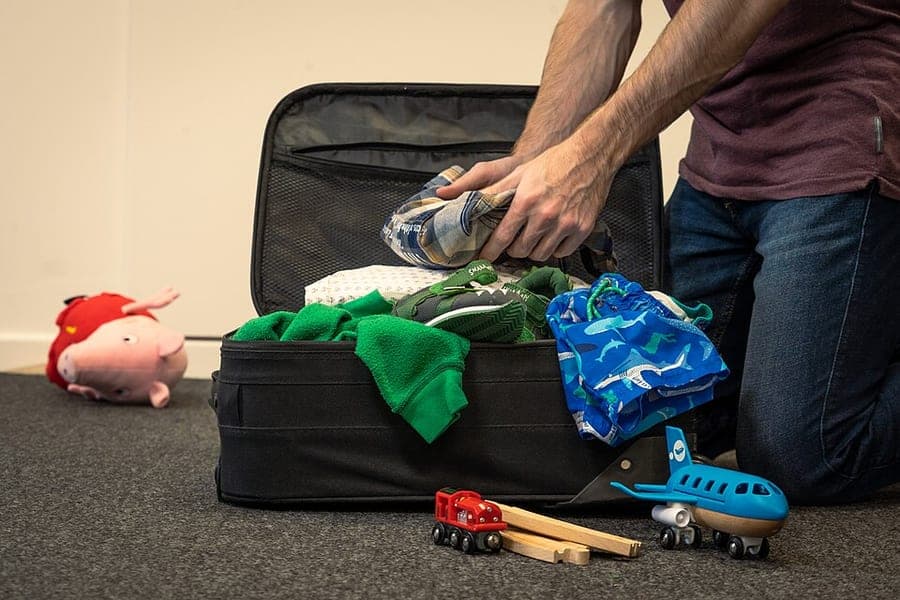
Clothing occupies fabric volume plus trapped air. A regular cube contains both. A compression cube’s second zip reduces the container, forcing the air out through the fabric and leaving the garments packed tighter.
That is the whole of it, and it explains every other difference on this page. The volume returned equals the air removed, so the benefit scales with how much air a garment holds — which varies by a factor of several between a down jacket and a pair of jeans.
What the second zip costs
| Product | Type | Published weight | Capacity | Compressed |
|---|---|---|---|---|
| Peak Design Packing Cube (Small) | Compression | 3.99 oz | 9 L | 4.5 L |
| Peak Design Packing Cube (Medium) | Compression | 5.1 oz | 18 L | 3.1 in deep |
| Eagle Creek Pack-It Reveal Set | Regular | 8.1 oz | 11 L | — |
| Gonex Compression Cubes (4-piece) | Compression | 11.7 oz | Not published | Not published |
The Peak Design small cube is the clearest published evidence in the category: 9 L expanded, 4.5 L compressed. A genuine halving, published as a number rather than asserted as a benefit. The medium cube publishes the same thing in depth — 6.7 in down to 3.1 in.
Note the weight column, though. Peak Design’s compression cubes are lighter than Eagle Creek’s regular set, which shows the weight penalty of compression is smaller than the variation between brands. Compression is not inherently heavy; some compression cubes are simply better made than some regular ones.
Which garments make it worth it
| Garment | Air content | Compression benefit |
|---|---|---|
| Down or synthetic puffer | Very high — loft is the design | Dramatic |
| Fleece | High | Substantial |
| Knitwear, jumpers | High | Substantial |
| Towels | High | Substantial |
| T-shirts | Moderate | Modest — mostly closing gaps between folds |
| Shirts | Moderate | Modest |
| Trousers, chinos | Low | Small |
| Jeans, dense cotton | Very low | Negligible |
| Underwear, socks | Low when rolled | Negligible |
The practical read: compression is a cold-weather feature. Pack a fleece and a jacket and it earns its weight several times over. Pack for a warm destination in t-shirts and light trousers and you have bought extra zips you will not use.
The answer most people should give
Buy one of each, or one cube that does both. The clothing in a typical carry-on splits neatly:
- Compression cube for the fleece, the jumper and the jacket if it is not being worn. This is where the volume is.
- Regular cube for t-shirts, shirts, underwear and socks — nothing there compresses meaningfully, so you are carrying an unused zip.
- Or a single cube that expands and compresses, which is the Peak Design approach and the neatest answer: it is a regular cube at 18 L and a compression cube at half the depth, and you decide per trip.
The regular cube ranking and the compression ranking both exist because the answer is genuinely trip-dependent.
Two catches worth knowing
A fully compressed cube is rigid. It has square corners and no give, and a suitcase interior is full of wheel wells and radiused corners that loose clothing fills and a hard block does not. Compressing everything can waste as much volume as it saves in a small case — a milder version of the vacuum-bag brick problem.
Compression does not reduce weight. Nothing about squeezing air out makes your clothes lighter, and a smaller bag invites you to pack more. On a carrier that publishes a weight cap, compression can take you to the limit while leaving space unused.
Two zips, two failure points
The compression zip does more work than the main one — it is pulled against resistance every time, which is exactly the load a zip is least happy with. It is the part most likely to fail on a compression cube, and it is why a published warranty is worth more here than on a plain cube.
Peak Design and Eagle Creek both publish lifetime terms, at $1.50 to $2.95 per covered year. The budget compression sets we track publish no warranty term at all, which on a two-zip product is a more meaningful omission than it would be on a one-zip one.
Every pick, with the working
Each entry below shows the published inputs, the four axis scores they produce, and what you give up. The order is the computed order, not a commercial one.
1 · A single cube doing the whole job in a 40 L bag
Peak Design Packing Cube (Medium)
18 L in one cube for 5.1 oz, with a divider that separates worn clothes from clean — the only cube here that solves the second half of a trip.
- Published size
- 12.6 × 12.6 × 6.7 in
- Weight
- 0.32 lb
- Capacity
- 18 L
- Weight per liter
- 0.02 lb/L
- Cost per covered year
- $2.00/yr
- Published list price
- $39.95
Warranty Peak Design lifetime guarantee
Fits 11 of 11 US carriers: AA, DL, UA, WN, AS, B6, F9, G4, HA, MX, SY. See the limits.
What it does well
- 18 L in 5.1 oz is 0.018 lb per liter, the best carry efficiency in the packing category
- Halves in depth from 6.7 in to 3.1 in as it empties
- Dual compartments keep clean and dirty apart without a second bag
What you give up
- $39.95 for one cube against $59 for a three-cube Eagle Creek set
- 12.6 in square footprint wastes corners in a 14 in wide case
- Compression here reduces the cube, not the clothes inside it
The arithmetic behind the score
- Value 9.5/10 — $39.95 ÷ 20 yr = $2.00/yr; $39.95 ÷ 18 L = $2.22/L
- Airline-fit breadth 10.0/10 — Fits the published carry-on limit at 11 of 11 US carriers: AA, DL, UA, WN, AS, B6, F9, G4, HA, MX, SY
- Carry efficiency 10.0/10 — 0.32 lb ÷ 18 L = 0.018 lb/L
- Warranty & support 8.0/10 — no stated end date (6 of 6); repair published (+2); airline damage not covered (+0)
Weights and breakpoints are published on how we rank. Where an input is not published, that axis is dropped and the remaining weights are re-normalized.
Specs: Peak Design published specifications and price, compiled 3 September 2026. Published compressed at 12.6 × 12.6 × 3.1 in and expanded at 12.6 × 12.6 × 6.7 in. The expanded figure is used here.
2 · Personal-item bags and 20 L daypacks
Peak Design Packing Cube (Small)
The medium cube's mechanism at half the volume — worth it only if 18 L is genuinely more cube than your bag can take.
- Published size
- Not published
- Weight
- 0.25 lb
- Capacity
- 9 L
- Weight per liter
- 0.03 lb/L
- Cost per covered year
- $1.50/yr
- Published list price
- $29.95
Warranty Peak Design lifetime guarantee
Fits No published dimensions to check.
What it does well
- Compresses from 9 L to 4.5 L, a true halving
- 3.99 oz added weight
- Same lifetime guarantee as the medium
What you give up
- $29.95 for 9 L against $39.95 for 18 L — the medium is better value per liter
- Small cubes encourage more cubes, and each one is added weight
- No mesh front, so you open it to see inside
The arithmetic behind the score
- Value 8.8/10 — $29.95 ÷ 20 yr = $1.50/yr; $29.95 ÷ 9 L = $3.33/L
- Airline-fit breadth not scored — No published dimensions to check against carrier limits.
- Carry efficiency 10.0/10 — 0.25 lb ÷ 9 L = 0.028 lb/L
- Warranty & support 8.0/10 — no stated end date (6 of 6); repair published (+2); airline damage not covered (+0)
Weights and breakpoints are published on how we rank. Where an input is not published, that axis is dropped and the remaining weights are re-normalized.
Specs: Peak Design published specifications and price, compiled 3 September 2026. Published at 32 × 17 × 8 cm compressed, 32 × 17 × 17 cm expanded.
3 · Anyone who wants cubes once and never again
Eagle Creek Pack-It Reveal Packing Cube Set (XS/S/M)
11 L of organization for 8.2 oz of added weight, under a warranty with no end date — the cleanest arithmetic in the packing category.
- Published size
- Not published
- Weight
- 0.51 lb
- Capacity
- 11 L
- Weight per liter
- 0.05 lb/L
- Cost per covered year
- $2.95/yr
- Published list price
- $59
Warranty Eagle Creek lifetime warranty
Fits No published dimensions to check.
What it does well
- Published weights of 45.4 g, 70.9 g and 113.4 g total 229.7 g — 8.1 oz for the set
- Lifetime warranty at $2.95 per covered year
- Mesh fronts mean you can see what is in a cube without opening it
What you give up
- $59 published is four to six times what an unbranded six-piece set lists at
- Organizing cubes, not compression cubes — they will not shrink anything
- 11 L across three cubes fills a fraction of a 40 L bag
The arithmetic behind the score
- Value 7.4/10 — $59 ÷ 20 yr = $2.95/yr; $59 ÷ 11 L = $5.36/L
- Airline-fit breadth not scored — No published dimensions to check against carrier limits.
- Carry efficiency 10.0/10 — 0.51 lb ÷ 11 L = 0.046 lb/L
- Warranty & support 8.0/10 — no stated end date (6 of 6); repair published (+2); airline damage not covered (+0)
Weights and breakpoints are published on how we rank. Where an input is not published, that axis is dropped and the remaining weights are re-normalized.
Specs: Eagle Creek published specifications and price, compiled 3 September 2026. Published per cube: XS 7.5 × 4.5 × 2.5 in, S 10 × 7 × 3 in, M 14 × 10 × 3 in.
4 · First-time cube buyers testing whether cubes suit them at all
Gonex Compression Packing Cubes (4-piece set)
Real compression zips across four sizes at 11.7 oz for the set — the honest budget answer, with no warranty behind it.
- Published size
- 17.3 × 13 × 3.54 in
- Weight
- 0.73 lb
- Capacity
- Not published
- Weight per liter
- Not published
- Cost per covered year
- Not published
- Published list price
- Not published
Warranty No warranty term published
Fits 11 of 11 US carriers: AA, DL, UA, WN, AS, B6, F9, G4, HA, MX, SY. See the limits.
What it does well
- Four graduated sizes with genuine compression zips
- 11.7 oz for the whole set, published
- Published 20 lb load rating per cube
What you give up
- No published warranty term of any kind
- Ripstop nylon at this tier abrades where a 300D polyester will not
- No published packed capacity, so cost per liter cannot be computed
The arithmetic behind the score
- Value not scored — No manufacturer-published price, so this axis is not scored.
- Airline-fit breadth 10.0/10 — Fits the published carry-on limit at 11 of 11 US carriers: AA, DL, UA, WN, AS, B6, F9, G4, HA, MX, SY
- Carry efficiency not scored — No published capacity, so weight per liter cannot be computed.
- Warranty & support 0.0/10 — no published term (0 of 6); no published repair route (+0); airline damage not covered (+0)
Weights and breakpoints are published on how we rank. Where an input is not published, that axis is dropped and the remaining weights are re-normalized.
Specs: Gonex published product specifications, compiled 3 September 2026. Published per cube: XL 17.3 × 13 × 3.54 in, L 14.5 × 10.6 × 3.54 in, M 11.8 × 8.9 × 3.54 in, S 9.8 × 7.5 × 3.54 in. Retail-only pricing. Check the live price before buying.
Prices last verified October 19, 2026. Prices move — the figure you see on Amazon at the moment you click is the real one.