Carry-On Rules for Food and Drink
One question decides everything: can you spread it or pour it? Solid food has no limit at all, and the arguments happen over peanut butter, yogurt and cheese.
We have not tested this gear. Every figure here is compiled from published manufacturer specifications and published airline policies, and the arithmetic is public so you can check it. This page contains affiliate links — see the affiliate disclosure.
Solid food has no quantity limit in a carry-on. The rule applies only to liquids, gels, aerosols, creams and pastes — so the test is whether you can spread it or pour it. A sandwich passes. Peanut butter does not, at any size over 3.4 oz, because it is a paste.
This page summarizes published TSA guidance. A screening officer has the final say on any item, international rules differ, and agricultural restrictions at your destination are a separate matter entirely. Sources are linked at the bottom.
| # | Product | Published capacity | Fits | Score | Price |
|---|---|---|---|---|---|
| 1 | Peak Design Packing Cube (Small)Personal-item bags and 20 L daypacks | 9 L | Not published | 8.9 | Check price on Amazon#ad How we earn |
| 2 | Osprey Daylite Plus 20L BackpackA personal item that is also the daypack for the whole trip | 20 L | 0 carriers | 6.8 | $89.95 · Check on Amazon#ad How we earn |
| 3 | BAGSMART Blast 4.5L Hanging Toiletry BagCarry-on-only travel inside the TSA 3-1-1 limit | 4.5 L | 11 of 11AA DL UA WN … | 5.7 | $17.99 · Check on Amazon#ad How we earn |
| 4 | Nalgene Wide Mouth Sustain Bottle (32 oz)Filling after the checkpoint and never buying airport water again | 0.95 L | 11 of 11AA DL UA WN … | 5.5 | $15.50 · Check on Amazon#ad How we earn |
Prices last verified October 21, 2026. Prices move — the figure you see on Amazon at the moment you click is the real one.
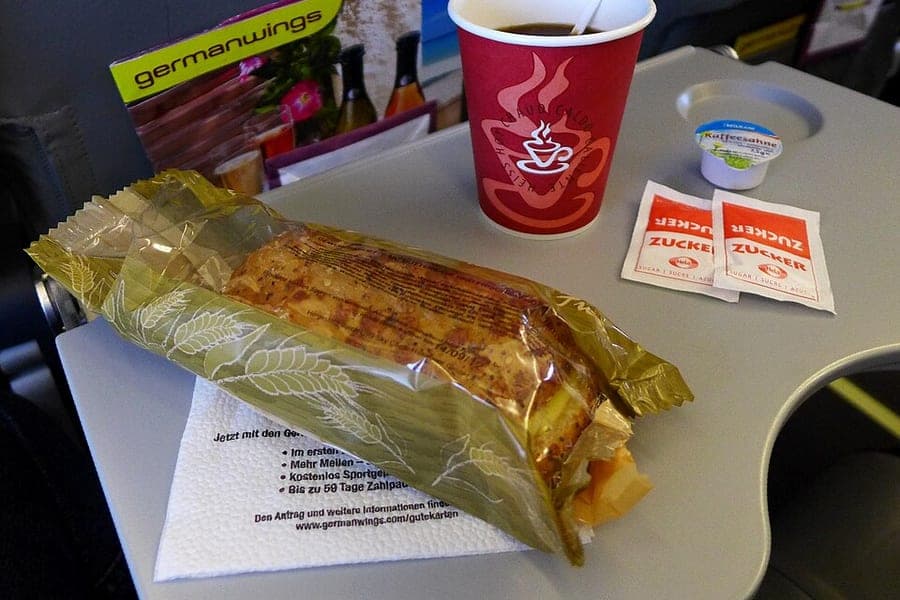
The test: spreadable or pourable
There is no separate “food rule”. Food is governed by the liquids rule, and the liquids rule covers liquids, gels, aerosols, creams and pastes. So the only question is which side of that line an item falls on.
| Item | Verdict | Why |
|---|---|---|
| A sandwich | Solid — no limit | Nothing in it pours |
| Whole fruit | Solid — no limit | But see the customs section below |
| Hard cheese | Solid — no limit | It does not spread |
| Soft cheese, brie | Treated as a spread | It spreads |
| Peanut butter | A paste — 3.4 oz cap | The classic argument, and it loses |
| Yogurt | A gel — 3.4 oz cap | It pours |
| Hummus, dips, salsa | 3.4 oz cap | All spreadable |
| Chocolate bar | Solid — no limit | Solid at room temperature |
| Cake and pie | Solid — no limit | Whole, and it may be inspected |
| Coffee beans, tea | Solid — no limit | Powders over 12 oz may need separate screening |
| Canned or jarred food | Liquid content — 3.4 oz cap | The liquid it sits in is the problem |
| Ice | Must be frozen solid | Partially melted, it is a liquid |
The pattern is consistent once you see it. Nobody is judging whether something is food; they are judging whether it behaves like a liquid at a checkpoint. The full 3-1-1 rule.
Water, and the bottle you should carry
A water bottle must be empty through the checkpoint, every time. It is then refillable airside, and that is the entire trick — the bottle passes, the water does not.
Worth noticing: the TSA quart bag is 0.95 L and a standard 32 oz bottle is also 0.95 L. That is a coincidence, and a useful one for remembering what a quart of volume actually looks like. Which bottle, and the arithmetic.
Drinks bought after security come aboard without restriction, which is why the coffee in your hand is fine and the one you brought from home is not.
Baby food is exempt, and it is generous
One of the largest exemptions in the whole rule. Baby formula, breast milk and baby food are permitted in reasonable quantities exceeding 3.4 oz, and they do not have to fit in the quart bag.
Two things about it that surprise people. It applies whether or not the child is traveling with you. And, like medically necessary liquids, the price of the exemption is a declaration at the start of screening rather than an explanation afterwards.
Powders, and the 12-ounce line
Less well known and increasingly enforced. Powder-like substances over roughly 12 oz or 350 ml in a carry-on may require additional screening and may need to be removed from the bag.
In practice this means protein powder, large containers of coffee, spices bought as gifts, and infant formula powder. None of it is prohibited — it is slower. If you are carrying a large quantity of anything powdered, put it where you can reach it.
The rule that actually costs people money
Everything above is about a checkpoint. The more expensive rule is at the other end: agricultural restrictions on arrival, which are enforced by customs rather than by security and carry real penalties.
- Fresh fruit, vegetables, meat, plants and seeds are restricted or prohibited on entry to many countries, the US and Australia among the stricter ones.
- The apple you did not eat is the classic case. It cleared security in one country and it is a declarable agricultural product in the next.
- Declare it, always. Declaring something that turns out to be prohibited costs you the item. Not declaring it can cost a great deal more.
- Domestic flights are usually fine, with genuine exceptions — Hawaii and some US territories restrict agricultural products from the mainland.
This is a customs question rather than a baggage one, and it is worth two minutes on the destination country’s own site before you pack food.
What to actually bring
- An empty bottle, filled after the checkpoint. Removes the dependence on a cart that comes round twice.
- Solid snacks — nuts, bars, dried fruit, a sandwich. No limit, no declaration, no argument.
- Something for a child, in reach rather than in a bin. This is the highest-value item on the list. The rest of the family cabin bag.
- Nothing that smells strongly in a sealed metal tube with two hundred people in it. Not a rule; a courtesy that everyone will thank you for.
- Nothing fresh that has to clear customs, unless you intend to eat it before landing.
Every pick, with the working
Each entry below shows the published inputs, the four axis scores they produce, and what you give up. The order is the computed order, not a commercial one.
1 · Personal-item bags and 20 L daypacks
Peak Design Packing Cube (Small)
The medium cube's mechanism at half the volume — worth it only if 18 L is genuinely more cube than your bag can take.
- Published size
- Not published
- Weight
- 0.25 lb
- Capacity
- 9 L
- Weight per liter
- 0.03 lb/L
- Cost per covered year
- $1.50/yr
- Published list price
- $29.95
Warranty Peak Design lifetime guarantee
Fits No published dimensions to check.
What it does well
- Compresses from 9 L to 4.5 L, a true halving
- 3.99 oz added weight
- Same lifetime guarantee as the medium
What you give up
- $29.95 for 9 L against $39.95 for 18 L — the medium is better value per liter
- Small cubes encourage more cubes, and each one is added weight
- No mesh front, so you open it to see inside
The arithmetic behind the score
- Value 8.8/10 — $29.95 ÷ 20 yr = $1.50/yr; $29.95 ÷ 9 L = $3.33/L
- Airline-fit breadth not scored — No published dimensions to check against carrier limits.
- Carry efficiency 10.0/10 — 0.25 lb ÷ 9 L = 0.028 lb/L
- Warranty & support 8.0/10 — no stated end date (6 of 6); repair published (+2); airline damage not covered (+0)
Weights and breakpoints are published on how we rank. Where an input is not published, that axis is dropped and the remaining weights are re-normalized.
Specs: Peak Design published specifications and price, compiled 3 September 2026. Published at 32 × 17 × 8 cm compressed, 32 × 17 × 17 cm expanded.
2 · A personal item that is also the daypack for the whole trip
Osprey Daylite Plus 20L Backpack
The only personal-item bag here with a published weight, a published price and a warranty that names no end date — $4 per covered year is the cheapest figure on this site.
- Published size
- 19 × 11 × 9.5 in
- Weight
- 1.31 lb
- Capacity
- 20 L
- Weight per liter
- 0.07 lb/L
- Cost per covered year
- $4/yr
- Published list price
- $80
Warranty All Mighty Guarantee — any reason, any product, any era
Fits No US carrier in our table publishes a limit these dimensions satisfy. See the limits.
What it does well
- $4.00 per covered year is the lowest cost-per-year figure in this ledger
- 1.31 lb for 20 L, and it is the bag you then use every day at the destination
- 19 × 11 × 9.5 in fits the published personal-item box at American, Southwest, Frontier and Allegiant
What you give up
- Over United's published 17 × 10 × 9 in limit on all three dimensions
- 20 L is genuinely small — this is a day bag, not a week's clothes
- No lockable zippers
The arithmetic behind the score
- Value 8.3/10 — $80 ÷ 20 yr = $4/yr; $80 ÷ 20 L = $4/L
- Airline-fit breadth 0.0/10 — Fits the published personal-item limit at 0 of 8 US carriers
- Carry efficiency 9.4/10 — 1.31 lb ÷ 20 L = 0.066 lb/L
- Warranty & support 10.0/10 — no stated end date (6 of 6); repair published (+2); covers airline damage (+2)
Weights and breakpoints are published on how we rank. Where an input is not published, that axis is dropped and the remaining weights are re-normalized.
Specs: Osprey published specifications and price, compiled 3 September 2026.
3 · Carry-on-only travel inside the TSA 3-1-1 limit
BAGSMART Blast 4.5L Hanging Toiletry Bag
Skip this one. Skip it as a food bag. It publishes 4.5 L of water-resistant polyester, which sounds ideal until you consider that a toiletry bag and a snack bag should never be the same object. This is a placement note, not a fault - the bag is good at its actual job.
4.5 L in a 10.6 oz bag that hangs — the smallest published toiletry volume here, which is the right size when the liquids rule caps you at a quart anyway.
- Published size
- 10.24 × 5.9 × 4.72 in
- Weight
- 0.66 lb
- Capacity
- 4.5 L
- Weight per liter
- 0.15 lb/L
- Cost per covered year
- Not published
- Published list price
- Not published
Warranty No warranty term published
Fits 11 of 11 US carriers: AA, DL, UA, WN, AS, B6, F9, G4, HA, MX, SY. See the limits.
What it does well
- 4.5 L published capacity is honest about how little liquid you can legally carry
- 10.6 oz published weight
- Hanging hook, which is the only thing that works in a hotel bathroom with no counter
What you give up
- No warranty term published
- 4.5 L is too small if you travel with a full skincare routine
- No separate quart bag included for the security tray
The arithmetic behind the score
- Value not scored — No manufacturer-published price, so this axis is not scored.
- Airline-fit breadth 10.0/10 — Fits the published carry-on limit at 11 of 11 US carriers: AA, DL, UA, WN, AS, B6, F9, G4, HA, MX, SY
- Carry efficiency 6.1/10 — 0.66 lb ÷ 4.5 L = 0.147 lb/L
- Warranty & support 0.0/10 — no published term (0 of 6); no published repair route (+0); airline damage not covered (+0)
Weights and breakpoints are published on how we rank. Where an input is not published, that axis is dropped and the remaining weights are re-normalized.
Specs: BAGSMART published specifications, compiled 3 September 2026. Retail-only pricing. Check the live price before buying.
4 · Filling after the checkpoint and never buying airport water again
Nalgene Wide Mouth Sustain Bottle (32 oz)
0.95 L of published capacity is, to within a rounding error, exactly the TSA quart — the same volume that caps your entire liquids allowance, in a bottle you carry through empty.
- Published size
- 8.25 × 3.5 × 3.5 in
- Weight
- 0.39 lb
- Capacity
- 0.95 L
- Weight per liter
- 0.41 lb/L
- Cost per covered year
- $0.85/yr
- Published list price
- $16.99
Warranty Nalgene lifetime guarantee
Fits 11 of 11 US carriers: AA, DL, UA, WN, AS, B6, F9, G4, HA, MX, SY. See the limits.
What it does well
- $16.99 published under a lifetime guarantee is $0.85 per covered year
- 6.25 oz for 32 oz of capacity, and the wide mouth takes ice and filters
- Published leakproof and dishwasher safe, which most collapsible bottles are not
What you give up
- 8.25 in tall and rigid — it does not compress when empty the way a soft flask does
- 3.5 in diameter competes with a laptop for the flat space in a personal item
- It must be empty at the checkpoint, every time, without exception
The arithmetic behind the score
- Value 5.0/10 — $16.99 ÷ 20 yr = $0.85/yr; $16.99 ÷ 0.95 L = $17.88/L
- Airline-fit breadth 10.0/10 — Fits the published carry-on limit at 11 of 11 US carriers: AA, DL, UA, WN, AS, B6, F9, G4, HA, MX, SY
- Carry efficiency 0.0/10 — 0.39 lb ÷ 0.95 L = 0.411 lb/L
- Warranty & support 6.0/10 — no stated end date (6 of 6); no published repair route (+0); airline damage not covered (+0)
Weights and breakpoints are published on how we rank. Where an input is not published, that axis is dropped and the remaining weights are re-normalized.
Specs: Nalgene published specifications and price, compiled 3 September 2026. Nalgene publishes a height of 8.25 in and a diameter of 3.5 in. The diameter is repeated on two axes for consistent formatting.
Prices last verified October 21, 2026. Prices move — the figure you see on Amazon at the moment you click is the real one.