The Best Travel Pillow
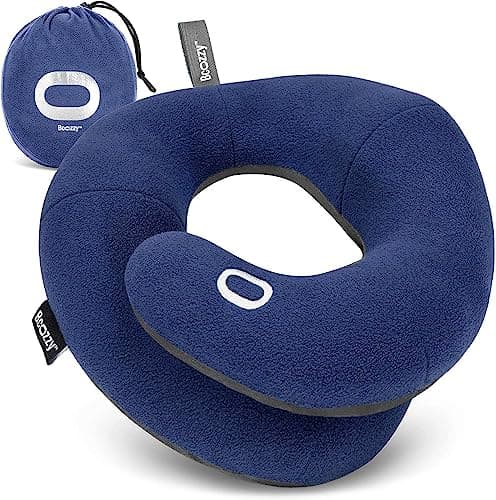
Almost every travel pillow fails the same way: it pushes your head forward off the seat. The fix is geometry, and it is the only spec worth shopping on.
We have not tested this gear. Every figure here is compiled from published manufacturer specifications and published airline policies, and the arithmetic is public so you can check it. This page contains affiliate links — see the affiliate disclosure.
The question is which way your head falls. Forward → a pillow whose arms overlap and close at the front. Sideways → a lateral brace rather than a horseshoe. Backward → almost any pillow works, and a flattened rear panel matters because a fat one pushes your head off the seat. That last failure is what ruins most travel pillows.
| # | Product | Published weight | Fits | Score | Price |
|---|---|---|---|---|---|
| 1 | BCOZZY Travel Neck PillowForward head-drop, at the lowest published weight here | 0.46 lb | 11 of 11AA DL UA WN … | 5.6 | $49.95 · Check on Amazon#ad How we earn |
| 2 | Trtl Pillow PlusHeads that fall sideways rather than forward | 0.56 lb | 11 of 11AA DL UA WN … | 5.6 | $84.99 · Check on Amazon#ad How we earn |
| 3 | Cabeau Evolution S3 Travel PillowOvernight flights in economy | 0.73 lb | 11 of 11AA DL UA WN … | 3.3 | $39.99 · Check on Amazon#ad How we earn |
Prices last verified October 19, 2026. Prices move — the figure you see on Amazon at the moment you click is the real one.
Why most travel pillows do not work
A conventional horseshoe pillow is the same thickness all the way round, including behind your neck. That rear section sits between your head and the headrest and pushes your head forward — which is the position you were trying to avoid. You end up with your chin on your chest and a sore neck, holding a pillow that made it worse.
Every design that works solves that problem one of three ways: it flattens the back panel, it braces the head laterally instead of surrounding it, or it wraps and closes at the front so the head cannot drop.
| Design | Solves | Fails at |
|---|---|---|
| Flattened rear panel | Head pushed forward off the seat | Lateral drop if the sides are shallow |
| Overlapping wrap-front arms | Head dropping forward | Bulk — it does not pack small |
| Lateral brace worn as a scarf | Head falling sideways | Nothing to lean back against |
| Plain horseshoe | Nothing in particular | The rear-panel problem |
| Inflatable | Packed volume | Support — air moves when your head does |
Work out which way your head falls
This is the whole decision and it takes one flight to establish. Notice where your head is when you wake up:
- Chin on chest → your head falls forward. You need a design whose arms overlap and close at the front. The BCOZZY is built around exactly that.
- Ear on shoulder, or lolling toward the window → sideways. You need a lateral brace with real height — the Trtl approach — rather than a horseshoe that just fills the gap.
- Head back against the headrest, and it is fine → almost anything works, and the priority is a flattened rear panel so the pillow does not create the forward-push problem you do not currently have. That is the Cabeau Evolution S3’s design.
The published numbers
| Pillow | Published weight | Dimensions | Published price | Warranty |
|---|---|---|---|---|
| BCOZZY Travel Neck Pillow | 7.4 oz | 11.02 × 9.84 × 4.72 in | Not published | None published |
| Cabeau Evolution S3 | 11.6 oz | 10 × 9.5 × 5.5 in | $39.99 | 1 yr (retail) |
| Trtl Pillow Plus | 9 oz | 8.7 × 8.7 × 3.6 in | $74.99 | None published |
The three things that are not the shape
- Heat. Memory foam is warm, and a full cabin is already warm. Fiber fill runs cooler, which is a genuine advantage on a long flight nobody mentions. The BCOZZY is fiber-filled; the Cabeau is memory foam with a quick-dry cover.
- Packed size. A pillow that does not compress is a pillow clipped to the outside of your bag, where it catches on things. The Cabeau publishes a compression case; the Trtl packs flat because it is not a ring.
- Weight. At 7.4 to 11.6 oz these are not heavy in absolute terms, but they are pure comfort weight — nothing else in your bag does less work per ounce. On Hawaiian’s published 25 lb carry-on cap a pillow is nearly three percent of the allowance.
Is a travel pillow worth carrying at all?
On a flight under about four hours, honestly no. You are unlikely to sleep, and the pillow is 10 oz and an awkward shape for the whole trip. This is the accessory most often bought at an airport and least often used twice.
On an overnight or transatlantic flight it is a different calculation entirely, because the alternative is arriving unable to function. If you fly long-haul more than once a year, buy the one matched to how your head falls and stop buying others.
Every pick, with the working
Each entry below shows the published inputs, the four axis scores they produce, and what you give up. The order is the computed order, not a commercial one.
1 · Forward head-drop, at the lowest published weight here
BCOZZY Travel Neck Pillow
The overlapping arms let you wrap the front closed, which is the cheapest available answer to a head that falls forward.
- Published size
- 11.02 × 9.84 × 4.72 in
- Weight
- 0.46 lb
- Capacity
- Not published
- Weight per liter
- Not published
- Cost per covered year
- Not published
- Published list price
- Not published
Warranty No warranty term published
Fits 11 of 11 US carriers: AA, DL, UA, WN, AS, B6, F9, G4, HA, MX, SY. See the limits.
What it does well
- 7.4 oz published, the lightest pillow in this category
- Overlapping arms wrap and hold at the front rather than gapping open
- Fiber fill rather than memory foam, so it runs cooler in a full cabin
What you give up
- No manufacturer-published price and no warranty term
- Fiber fill compresses over time in a way memory foam does not
- Bulky to pack — it does not compress into a small case
The arithmetic behind the score
- Value not scored — No manufacturer-published price, so this axis is not scored.
- Airline-fit breadth 10.0/10 — Fits the published carry-on limit at 11 of 11 US carriers: AA, DL, UA, WN, AS, B6, F9, G4, HA, MX, SY
- Carry efficiency not scored — No published capacity, so weight per liter cannot be computed.
- Warranty & support 0.0/10 — no published term (0 of 6); no published repair route (+0); airline damage not covered (+0)
Weights and breakpoints are published on how we rank. Where an input is not published, that axis is dropped and the remaining weights are re-normalized.
Specs: BCOZZY published product specifications, compiled 3 September 2026. Retail-channel pricing only. Check the live price before buying.
2 · Heads that fall sideways rather than forward
Trtl Pillow Plus
Skip this one. Skip it unless your head genuinely falls sideways. At $74.99 published it is the most expensive pillow here, Trtl publishes no warranty term at all, and it is worn like a scarf rather than sat in — which is a real thing to tolerate for eight hours. If your head drops forward, a wrap-front design solves that better and cheaper.
A scarf around an adjustable internal brace rather than a horseshoe of foam — it supports the head sideways, which is the direction it actually falls when you sleep sitting up.
- Published size
- 8.7 × 8.7 × 3.6 in
- Weight
- 0.56 lb
- Capacity
- Not published
- Weight per liter
- Not published
- Cost per covered year
- Not published
- Published list price
- $74.99
Warranty No warranty term published
Fits 11 of 11 US carriers: AA, DL, UA, WN, AS, B6, F9, G4, HA, MX, SY. See the limits.
What it does well
- Adjustable height and support via a dial, rather than one fixed shape
- Supports the head laterally, which is the failure direction a horseshoe ignores
- 9 oz published, and it packs flat rather than as a ring
What you give up
- $74.99 is the highest published price in this category and no warranty term is published
- It is worn like a scarf, which not everyone will tolerate for eight hours
- Nothing to lean back against — it does not replace headrest support
The arithmetic behind the score
- Value not scored — No published warranty term or capacity to divide the price by.
- Airline-fit breadth 10.0/10 — Fits the published carry-on limit at 11 of 11 US carriers: AA, DL, UA, WN, AS, B6, F9, G4, HA, MX, SY
- Carry efficiency not scored — No published capacity, so weight per liter cannot be computed.
- Warranty & support 0.0/10 — no published term (0 of 6); no published repair route (+0); airline damage not covered (+0)
Weights and breakpoints are published on how we rank. Where an input is not published, that axis is dropped and the remaining weights are re-normalized.
Specs: Trtl published specifications and price, compiled 3 September 2026.
3 · Overnight flights in economy
Cabeau Evolution S3 Travel Pillow
A flattened rear cushion so your head sits against the seat rather than being pushed off it — the one design decision that separates travel pillows that work from ones that do not.
- Published size
- 10 × 9.5 × 5.5 in
- Weight
- 0.73 lb
- Capacity
- Not published
- Weight per liter
- Not published
- Cost per covered year
- $39.99/yr
- Published list price
- $39.99
Warranty 1 year warranty as published at retail; Cabeau's own site states a lifetime warranty. The shorter published figure is used here.
Fits 11 of 11 US carriers: AA, DL, UA, WN, AS, B6, F9, G4, HA, MX, SY. See the limits.
What it does well
- Flattened back panel removes the forward head push that ruins most neck pillows
- 11.6 oz published, and it compresses into its own case
- Seat strap stops it migrating when you actually fall asleep
What you give up
- Two different warranty terms are published for the same product, which is not reassuring
- $40 per covered year on the shorter of those two terms
- Memory foam is warm, which is the wrong property in a full cabin
The arithmetic behind the score
- Value 0.0/10 — $39.99 ÷ 1 yr = $39.99/yr
- Airline-fit breadth 10.0/10 — Fits the published carry-on limit at 11 of 11 US carriers: AA, DL, UA, WN, AS, B6, F9, G4, HA, MX, SY
- Carry efficiency not scored — No published capacity, so weight per liter cannot be computed.
- Warranty & support 0.5/10 — 1 yr (0.5 of 6); no published repair route (+0); airline damage not covered (+0)
Weights and breakpoints are published on how we rank. Where an input is not published, that axis is dropped and the remaining weights are re-normalized.
Specs: Cabeau published specifications and price, compiled 3 September 2026.
Prices last verified October 19, 2026. Prices move — the figure you see on Amazon at the moment you click is the real one.