The Best Travel Booster Seat
A booster seat is the one piece of child travel gear federal regulation names as not approved for use on an aircraft. It flies as cargo and works at the other end - which makes packed size, not comfort, the specification that decides it.
We have not tested this gear. Every figure here is compiled from published manufacturer specifications and published airline policies, and the arithmetic is public so you can check it. This page contains affiliate links — see the affiliate disclosure.
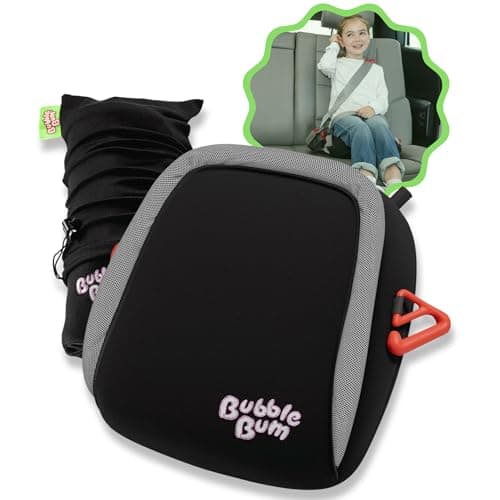
The BubbleBum for most families flying: a published 15 oz, deflating to 12 × 6 × 4 in, with the widest child range here (40–110 lb) and the only lifetime guarantee of the five. The mifold Comfort if space is the constraint — it folds to 194 cubic inches, about 7 percent of a carry-on box. And know this before you shop: federal regulation publishes that booster seats “are not approved for use in aircraft.” This is gear for the car at the other end, carried through the airport and nothing more.
Manufacturer-published listing figures and live prices read 15 October 2026. Packed volumes and carry-on-box percentages are computed by us from those published dimensions. We have not tested or crash-tested any of these, and nothing here is a safety assessment — the regulations below are quoted from the Code of Federal Regulations rather than paraphrased.
| # | Product | Published weight | Fits | Score | Price |
|---|---|---|---|---|---|
| 1 | BubbleBum Inflatable Booster SeatFlying to a rental car, or a child who outgrows things quickly | 0.94 lb | 11 of 11AA DL UA WN … | 8.2 | $29.59 · Check on Amazon#ad How we earn |
| 2 | mifold Comfort Grab-and-Go BoosterPacking a booster you will barely notice carrying | 1.6 lb | 11 of 11AA DL UA WN … | 5.8 | $74.95 · Check on Amazon#ad How we earn |
| 3 | Diono Solana Lite Backless BoosterClipping to a backpack for a rental-car trip, on the smallest budget here | 1.9 lb | 4 of 11WN F9 G4 SY | 2.2 | $24.99 · Check on Amazon#ad How we earn |
| 4 | mifold hifold Fit-and-Fold High-Back BoosterA child who falls asleep in the car, when the trip is driven rather than flown | 10 lb | 1 of 11SY | 0.5 | $219.95 · Check on Amazon#ad How we earn |
| 5 | Graco TurboBooster 2.0 Backless BoosterThe back seat of your own car, where it never has to be carried | 4.4 lb | 0 carriers | 0.2 | $34.99 · Check on Amazon#ad How we earn |
Prices last verified October 19, 2026. Prices move — the figure you see on Amazon at the moment you click is the real one.
The rule that defines the whole category
Most guides to travel boosters open with comfort. The useful place to start is the regulation, because it settles what a travel booster is actually for.
14 CFR 121.311, which governs seats and safety belts on US air carriers, publishes that “booster-type child restraint systems (as defined in Federal Motor Vehicle Safety Standard No. 213 (49 CFR 571.213)), vest- and harness-type child restraint systems, and lap held child restraints are not approved for use in aircraft.” The same section goes further and puts the duty on the airline: “no certificate holder may permit a child, in an aircraft, to occupy a booster-type child restraint system … during take off, landing, and movement on the surface.”
That is not an airline policy you can shop around, and it is not about the product being cheap or foreign or uncertified. It applies to the $220 high-back on this page exactly as it applies to the $40 inflatable.
The regulation does name exceptions, and they are narrow: a device approved by the FAA through a Type Certificate or Supplemental Type Certificate, or one approved under § 21.8(d) or Technical Standard Order C-100b or later. It then names exactly one product by part number — the AmSafe CARES harness, Part No. 4082.
Which produces the gap families actually run into. CARES is published for children 22–44 lb. Boosters start at 40 lb. So a child who has outgrown the CARES has two legal options in the air: an FAA-approved car seat used with its own harness, or the aircraft seat belt on its own. Our car seat and harness page works through that decision; this page is about the thing you carry for the ground.
Why every booster here starts at exactly 40 pounds
Look down the five picks and the minimum weight is 40 lb on every single one. That is not five brands converging on a number. It is a labeling rule.
FMVSS 213 (49 CFR 571.213) requires makers to publish the weight and height ranges of children who can safely use a restraint in each mode, and then constrains what they may recommend: manufacturers “shall not recommend booster seats for children of masses less than 18.4 kg (40 lb).”
So the floor is federal, and the differences between products are at the top of the range and on height. The BubbleBum publishes 40–110 lb and 41–57 in; the mifold Comfort publishes 40–100 lb but starts at 43.5 in, the highest floor of the five. If your child is newly 40 lb and short for their age, that single figure can rule a product out.
Weight and bulk are different problems
Every travel booster is marketed on one number, and it is almost always weight. That is the wrong number on its own, because the thing competing for space in your bag is volume. We computed both from the published dimensions.
| Booster | Published weight | Published packed size | Packed volume | Share of a carry-on box |
|---|---|---|---|---|
| mifold Comfort | 1.6 lb | 9.84 × 6.69 × 2.95 in | 194 in³ | 7.0% |
| BubbleBum (deflated) | 15 oz | 12 × 6 × 4 in | 288 in³ | 10.4% |
| Diono Solana Lite | 1.9 lb | 15.16 × 14.96 × 6.3 in | 1,429 in³ | 51.5% |
| mifold hifold (folded) | 10 lb | 14.6 × 13.5 × 10.7 in | 2,109 in³ | 76.1% |
| Graco TurboBooster 2.0 | 4.4 lb | Does not fold | 2,312 in³ | 83.4% |
Two results fall out of that, and neither is what the packaging says.
First: weight tells you almost nothing about how much room a booster takes. The Diono Solana Lite publishes 1.9 lb — just 0.3 lb more than the mifold Comfort, a difference you would never notice. It also publishes 15.16 × 14.96 × 6.3 in, which is 1,429 cubic inches — 7.4 times the mifold’s packed volume, and over half a carry-on box on its own. Same weight class, completely different bag problem.
Second: the ordinary booster is the size of your luggage. The Graco at 2,312 cubic inches is 83 percent of an entire carry-on box, and it does not fold, so there is no packed figure to quote — that is simply its size, always. Against the mifold Comfort that is a factor of nearly twelve, for two products that perform the same function in the same car.
The five, and who each one is for
BubbleBum — the one to fly with
At a published 15 oz it is the lightest thing here by a clear margin, it deflates to 12 × 6 × 4 in, and it publishes the widest child range of the five at 40–110 lb and ages 4–11. BubbleBum publishes it as independently crash tested to exceed FMVSS 213, narrow enough to put three across a back seat, and backed by a lifetime guarantee — the only one on this page that does not expire after a year.
The honest costs: you inflate it with your mouth, a published 20 seconds, in a rental car park after a flight. It packs to 288 cubic inches, which is bigger than the mifold. And an inflatable cushion is the one construction here that a puncture can end, which no rigid pick shares.
mifold Comfort — the one that disappears
194 cubic inches folded is the smallest packed size on this page by a factor of nearly seven, and mifold publishes it as fitting a regular backpack or a glove box. If the constraint is that you are already at your bag limit, this is the pick that costs you almost nothing to bring. It publishes a 1 year warranty, which two of the five do not manage at all.
Two things to weigh. Its 43.5 in minimum height is the highest floor here, so a newly-40 lb child may not qualify for it when they qualify for the BubbleBum. And mifold publishes a genuinely different mechanism: “Instead of lifting the child up, the grab-and-go car seat adjusts the adult seat belt by pulling it down to fit the child.” Every other pick on this page raises the child. We are not in a position to judge which performs better — we have crash tested nothing — but you should know you are buying a different approach, not a smaller version of the same one.
Diono Solana Lite — the cheapest way to carry one
The budget pick, and the only one here that publishes a way to attach itself to something you already carry: a carabiner that clips the seat to a backpack handle for hands-free walking. It is also the only backless pick publishing the newer FMVSS 213B standard rather than FMVSS 213, with a machine-washable polyester cover and a published 12 month warranty where two picks here publish no term at all. At a published 15.16 in wide it is narrow enough for three across most back seats.
Against it: 1,429 cubic inches is over half a carry-on box — 7.4 times the mifold’s volume for 0.3 lb more weight, which is the trade this whole page is about. Its 14.96 in second axis misses the standard 22 × 14 × 9 in carry-on box at seven of the eleven carriers we track. And Diono publishes two different weights for it — 1.8 lb in its bullet copy against 1.9 lb in the specification field. We print the specification figure and flag the discrepancy rather than picking the flattering one.
mifold hifold — the only one with a back
Every other pick here is backless, which means nothing supports a sleeping child’s head. The hifold is the exception: a folding high-back with a published 243 adjustment settings across seat, body, head width and height, and the only pick publishing the newer FMVSS 213b rather than FMVSS 213. There is a built-in carry strap.
It is also 10 lb — more than six times the mifold Comfort, over ten times the BubbleBum — and folds to 10.7 in deep, which is over the 9 in carry-on depth limit at most US carriers. No warranty term is published and it is by a wide margin the most expensive pick here. Buy it for a long drive or a car that will keep it, not for a terminal.
Graco TurboBooster 2.0 — the one to leave home
We have named it the skip, and it deserves a fair hearing anyway, because it is the best car booster on this page. It is the cheapest, it has height-adjustable armrests and two cup holders that nothing else here offers, and Graco publishes a named crash-test program covering frontal, rear and rollover plus extreme-temperature testing — more detail than any travel pick publishes about itself.
It just cannot travel. 17 × 17 × 8 in that does not fold is 2,312 cubic inches of permanent size. Buy it for the back seat of your own car, where it is never carried anywhere, and buy one of the others for trips.
Choosing between them in one pass
- Flying to a rental car, one child: BubbleBum. Lightest, widest child range, lifetime guarantee, cheapest of the travel-specific picks.
- Already at your bag limit: mifold Comfort, if your child clears 43.5 in. Nothing else here takes 7 percent of a carry-on box.
- Both hands full in the airport: Diono Solana Lite, for the carabiner that clips it to a backpack. Accept the bulk.
- A child who sleeps in the car, on a driving trip: hifold. It is the only one with a head to lean on.
- Three children across one back seat: BubbleBum publishes a narrow fit for exactly this, and it is the only pick that does.
One more option that costs nothing: ask the rental company. Most publish child seats as an add-on, usually per-day, and for a single short trip that can beat buying. What it cannot do is guarantee which model turns up or what condition it is in, which is the reason most families end up carrying their own. Packing for a family trip covers fitting the thing you chose into the allowance you have.
Every pick, with the working
Each entry below shows the published inputs, the four axis scores they produce, and what you give up. The order is the computed order, not a commercial one.
1 · Flying to a rental car, or a child who outgrows things quickly
BubbleBum Inflatable Booster Seat
15 oz published is the lightest booster here, it deflates flat, and it is the only one of the five publishing a lifetime guarantee. It also publishes the widest child range of any pick - 40 to 110 lb - so it is the one that stays useful longest.
- Published size
- 12 × 6 × 4 in
- Weight
- 0.94 lb
- Capacity
- Not published
- Weight per liter
- Not published
- Cost per covered year
- Not published
- Published list price
- Not published
Warranty Product lifetime manufacturer's guarantee, published with no term
Fits 11 of 11 US carriers: AA, DL, UA, WN, AS, B6, F9, G4, HA, MX, SY. See the limits.
What it does well
- 15 oz published - the lightest of the five, by a whole pound against the Graco
- 40-110 lb published, the widest child range here, and narrow enough for three across a back seat
- The only booster here publishing a lifetime guarantee rather than a one-year term
What you give up
- You inflate it by mouth - a published 20 seconds, but a step the rigid boosters do not have
- 288 cubic inches packed is bigger than the mifold's 194, so it is light rather than smallest
- An inflatable cushion is the one construction here that can be punctured
The arithmetic behind the score
- Value not scored — No manufacturer-published price, so this axis is not scored.
- Airline-fit breadth 10.0/10 — Fits the published carry-on limit at 11 of 11 US carriers: AA, DL, UA, WN, AS, B6, F9, G4, HA, MX, SY
- Carry efficiency not scored — No published capacity, so weight per liter cannot be computed.
- Warranty & support 6.0/10 — no stated end date (6 of 6); no published repair route (+0); airline damage not covered (+0)
Weights and breakpoints are published on how we rank. Where an input is not published, that axis is dropped and the remaining weights are re-normalized.
Specs: BubbleBum published listing specifications, compiled 3 September 2026. 12 x 6 x 4 in is the booster deflated and packed, which is the figure that matters on a trip. Inflated it publishes 12 x 11 x 4 in. 288 cubic inches packed - about a tenth of a standard carry-on box. Retail-channel pricing only. Check the live price before buying.
2 · Packing a booster you will barely notice carrying
mifold Comfort Grab-and-Go Booster
194 cubic inches folded is less than any other booster here by a factor of nearly seven, and it is the pick that genuinely disappears into a bag you already packed. The trade is a 43.5 in minimum height, the highest of the five.
- Published size
- 9.84 × 6.69 × 2.95 in
- Weight
- 1.6 lb
- Capacity
- Not published
- Weight per liter
- Not published
- Cost per covered year
- Not published
- Published list price
- Not published
Warranty 1 year manufacturer warranty from date of purchase, published
Fits 11 of 11 US carriers: AA, DL, UA, WN, AS, B6, F9, G4, HA, MX, SY. See the limits.
What it does well
- 194 cubic inches folded, about 7 percent of a carry-on box - the smallest packed size here
- Published to fit a regular backpack or a glove box, which is the whole point of the category
- Publishes a warranty term, which two of the five do not
What you give up
- 43.5 in minimum height published - the highest floor here, so it excludes the smallest children who still need a booster
- It works by pulling the adult belt down to the child rather than raising the child up, which is a different mechanism from every other pick on this page
- 1.6 lb published - heavier than the BubbleBum, which is lighter at 15 oz and only a third bulkier packed
The arithmetic behind the score
- Value not scored — No manufacturer-published price, so this axis is not scored.
- Airline-fit breadth 10.0/10 — Fits the published carry-on limit at 11 of 11 US carriers: AA, DL, UA, WN, AS, B6, F9, G4, HA, MX, SY
- Carry efficiency not scored — No published capacity, so weight per liter cannot be computed.
- Warranty & support 0.5/10 — 1 yr (0.5 of 6); no published repair route (+0); airline damage not covered (+0)
Weights and breakpoints are published on how we rank. Where an input is not published, that axis is dropped and the remaining weights are re-normalized.
Specs: mifold published listing specifications, compiled 3 September 2026. 9.84 x 6.69 x 2.95 in is the booster folded, which is 194 cubic inches - about 7 percent of a standard carry-on box, and the smallest packed size of any pick on this page. Retail-channel pricing only. Check the live price before buying.
3 · Clipping to a backpack for a rental-car trip, on the smallest budget here
Diono Solana Lite Backless Booster
The cheapest way to carry a booster rather than rent one, and the only pick here that publishes a way to attach it to a bag you already have. The catch is bulk: 1,429 cubic inches is over half a carry-on box for a seat weighing 0.3 lb more than the mifold.
- Published size
- 15.16 × 14.96 × 6.3 in
- Weight
- 1.9 lb
- Capacity
- Not published
- Weight per liter
- Not published
- Cost per covered year
- Not published
- Published list price
- Not published
Warranty 12 months manufacturer warranty, published in the listing
Fits 4 of 11 US carriers: WN, F9, G4, SY. See the limits.
What it does well
- A published carabiner that clips to a backpack handle, so it can be carried hands-free
- Publishes FMVSS 213B - the newer standard, matched here only by the hifold
- Machine-washable polyester cover and a published 12 month warranty, where two picks publish no term at all
What you give up
- 1,429 cubic inches is over half a carry-on box - 7.4 times the mifold's volume for 0.3 lb more weight
- Diono's own listing publishes two different weights: 1.8 lb in its bullet copy and 1.9 lb in the specification field. We print the specification figure
- At 14.96 in across its second axis it misses the 22 x 14 x 9 in carry-on box used by most US carriers
The arithmetic behind the score
- Value not scored — No manufacturer-published price, so this axis is not scored.
- Airline-fit breadth 3.6/10 — Fits the published carry-on limit at 4 of 11 US carriers: WN, F9, G4, SY
- Carry efficiency not scored — No published capacity, so weight per liter cannot be computed.
- Warranty & support 0.5/10 — 1 yr (0.5 of 6); no published repair route (+0); airline damage not covered (+0)
Weights and breakpoints are published on how we rank. Where an input is not published, that axis is dropped and the remaining weights are re-normalized.
Specs: Diono published listing specifications, compiled 3 September 2026. 15.16 x 14.96 x 6.3 in published, which is 1,429 cubic inches - just over half a standard carry-on box, and roughly seven and a half times the mifold's packed volume for only 0.3 lb more weight. Retail-channel pricing only. Check the live price before buying.
4 · A child who falls asleep in the car, when the trip is driven rather than flown
mifold hifold Fit-and-Fold High-Back Booster
The only high-back on this page, and the only one that supports a head. Published at 10 lb and folding to 76 percent of a carry-on box, it is a car-trip booster that happens to fold - not a thing you want to carry through a terminal.
- Published size
- 14.6 × 13.5 × 10.7 in
- Weight
- 10 lb
- Capacity
- Not published
- Weight per liter
- Not published
- Cost per covered year
- Not published
- Published list price
- Not published
Warranty No warranty term published in the listing
Fits 1 of 11 US carriers: SY. See the limits.
What it does well
- The only pick here with a back and head support, which is what a sleeping child actually needs
- 243 published adjustment settings across seat, body, head width and height - nothing else here adjusts at all
- Publishes FMVSS 213b, the newer version of the standard, where the others publish FMVSS 213
What you give up
- 10 lb published - more than six times the mifold Comfort and over ten times the BubbleBum
- 10.7 in deep folded, so it is over the 9 in carry-on depth limit at most US carriers
- No warranty term published, and it is by a wide margin the most expensive pick here
The arithmetic behind the score
- Value not scored — No manufacturer-published price, so this axis is not scored.
- Airline-fit breadth 0.9/10 — Fits the published carry-on limit at 1 of 11 US carriers: SY
- Carry efficiency not scored — No published capacity, so weight per liter cannot be computed.
- Warranty & support 0.0/10 — no published term (0 of 6); no published repair route (+0); airline damage not covered (+0)
Weights and breakpoints are published on how we rank. Where an input is not published, that axis is dropped and the remaining weights are re-normalized.
Specs: mifold published listing specifications, compiled 3 September 2026. 14.6 x 13.5 x 10.7 in folded, which is 2,109 cubic inches - about 76 percent of a standard carry-on box. Its 10.7 in depth is over the 9 in carry-on limit at most US carriers. Retail-channel pricing only. Check the live price before buying.
5 · The back seat of your own car, where it never has to be carried
Graco TurboBooster 2.0 Backless Booster
Skip this one. Skip it for a trip, and buy it for your own car. The Graco is the cheapest thing on this page and the only pick publishing a named multi-mode crash-test program, with armrests and cup holders nothing else here has. But it does not fold, and at a published 17 x 17 x 8 in it is 2,312 cubic inches - 83 percent of an entire carry-on box, for one child's seat. Every other pick on this page exists because of that number.
The cheapest booster here and a perfectly good everyday one - height-adjustable armrests, cup holders, a published crash-test program none of the travel picks match. It also does not fold, and at 2,312 cubic inches it is the reason the rest of this page exists.
- Published size
- 17 × 17 × 8 in
- Weight
- 4.4 lb
- Capacity
- Not published
- Weight per liter
- Not published
- Cost per covered year
- Not published
- Published list price
- Not published
Warranty 1 year limited warranty, published
Fits No US carrier in our table publishes a limit these dimensions satisfy. See the limits.
What it does well
- Cheapest of the five, and the only pick publishing a named multi-mode crash-test program
- Height-adjustable armrests and two cup holders - the only pick here with either
- 1 year limited warranty published
What you give up
- 2,312 cubic inches - 83 percent of an entire carry-on box, for one child's seat
- 4.4 lb published and no fold at all, so there is no packed size, only this size
- 43-57 in published is the narrowest height window of the five
The arithmetic behind the score
- Value not scored — No manufacturer-published price, so this axis is not scored.
- Airline-fit breadth 0.0/10 — Fits the published carry-on limit at 0 of 11 US carriers
- Carry efficiency not scored — No published capacity, so weight per liter cannot be computed.
- Warranty & support 0.5/10 — 1 yr (0.5 of 6); no published repair route (+0); airline damage not covered (+0)
Weights and breakpoints are published on how we rank. Where an input is not published, that axis is dropped and the remaining weights are re-normalized.
Specs: Graco published listing specifications, compiled 3 September 2026. 17 x 17 x 8 in published, which is 2,312 cubic inches - 83 percent of a standard carry-on box, and the largest thing on this page. It does not fold. Retail-channel pricing only. Check the live price before buying.
Prices last verified October 19, 2026. Prices move — the figure you see on Amazon at the moment you click is the real one.