The Best Travel Water Filter
The whole category turns on one published distinction that almost nobody explains: a filter and a purifier do not protect against the same things, and which you need is a destination question.
We have not tested this gear. Every figure here is compiled from published manufacturer specifications and published airline policies, and the arithmetic is public so you can check it. This page contains affiliate links — see the affiliate disclosure.
A filter is not a purifier. A filter removes bacteria and parasites; only a purifier also removes viruses, and of the three here only the GRAYL GeoPress publishes that claim. Buy the LifeStraw Go for tap water you distrust on bacteria or taste — and know that its headline 4,000 L is the membrane, while the carbon filter beside it is published at 100 L, a fortieth of it. Buy the GeoPress where viruses are the published risk.
Manufacturer-published listing specifications, compiled 28 October 2026. Every removal claim below is quoted from the maker’s own listing; where a listing publishes no claim, this page says so rather than inferring one. Prices on the buy buttons are live. Nothing here is medical or public-health advice.
| # | Product | Published weight | Fits | Score | Price |
|---|---|---|---|---|---|
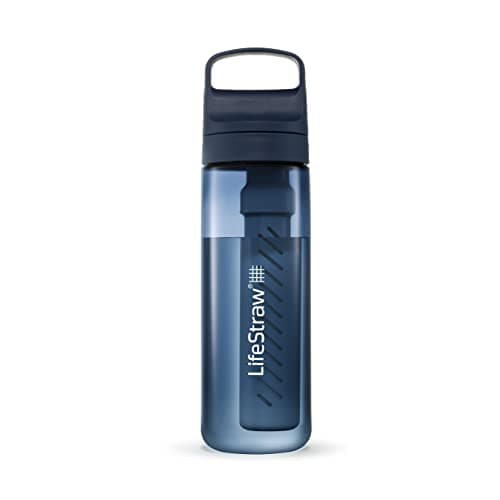
| 1 | LifeStraw Go Series Water Filter Bottle (22 oz)Tap water you distrust for taste or bacteria rather than for viruses | 0.55 lb | Not published | 0.0 | $37.46 · Check on Amazon#ad How we earn |
| 2 | GRAYL GeoPress Water Purifier (24 oz)Destinations where the published risk includes viruses, not just bacteria | 0.99 lb | Not published | 0.0 | $99.95 · Check on Amazon#ad How we earn |
| 3 | Katadyn BeFree AC 2-Stage Collapsible Bottle (1 L)Weight-counted packing where sediment and taste are the problem | 0.14 lb | Not published | 0.0 | $44.95 · Check on Amazon#ad How we earn |
Prices last verified November 5, 2026. Prices move — the figure you see on Amazon at the moment you click is the real one.
The distinction the category is built on
Waterborne pathogens come in three size classes, and they are not equally easy to stop. Protozoa (giardia, cryptosporidium) are the largest. Bacteria (E. coli, salmonella) are smaller. Viruses (norovirus, rotavirus, hepatitis A) are smaller again — small enough to pass straight through a membrane that stops the other two.
That is the whole reason the words differ. A filter is a physical membrane: it stops what is bigger than its pores. A purifier is rated to deal with viruses as well. On a spec sheet the tell is simple — does the maker name viruses? Two of the three products here do not.
The three, as published
| Product | Published as removing | Viruses? | Published filter life | Published weight | Bottle volume |
|---|---|---|---|---|---|
| LifeStraw Go Series | 99.999999% bacteria, 99.999% parasites, 99.999% microplastics | Not claimed | 4,000 L membrane / 100 L carbon | 0.545 lb | 22 oz |
| GRAYL GeoPress | Viruses, bacteria and protozoa, plus VOCs, PFAS and heavy metals | Yes — named | Not published | 0.994 lb | 24 oz per press |
| Katadyn BeFree AC | Sediment, fine particles, microplastics; taste | Not claimed | 1,000 L | 0.14 lb | 1 L |
The number that matters is the smaller one
LifeStraw publishes two filter lives, and they differ by a factor of 40:
- Membrane microfilter: up to 1,000 gal (4,000 L), published as about five years of daily use. This is the headline figure.
- Carbon filter: up to 26 gal (100 L), published as about two months.
The carbon stage is what reduces chlorine, odors and organic chemical matter — the taste. So the 4,000 L number describes how long the bottle keeps protecting you, and the 100 L number describes how long it keeps being pleasant to drink from. The second one governs your resupply, and it is the one that does not appear in the product name.
Credit where it is due: LifeStraw publishes both figures plainly, side by side. That is more than the GeoPress listing does, which publishes no cartridge life at all — so there is no published way to work out how long it lasts or what a liter of purified water costs through it.
Weight, and the one that is barely there
The spread here is wider than the products suggest:
| Product | Published weight | In ounces | Against the lightest |
|---|---|---|---|
| Katadyn BeFree AC | 0.14 lb | 2.24 oz | — |
| LifeStraw Go Series | 0.545 lb | 8.71 oz | 3.9× |
| GRAYL GeoPress | 0.994 lb | 15.90 oz | 7.1× |
The purifier weighs seven times the lightest filter here, and that is not waste — a press mechanism rated for viruses is simply more hardware than a hollow-fiber membrane in a soft flask. It is the honest price of the one capability the others do not publish.
The Katadyn is in a different class of object again: it is a soft bottle published to collapse flat, so an empty one occupies almost nothing. It publishes no collapsed dimension, which is the figure that would let you check it against the space you actually have.
This is a destination decision, not a gear preference
Our travel water bottle page ends by saying that where the tap is safe, a plain bottle replaces every bottle you would otherwise buy — and where it is not, a filter becomes the actual product you need. This page is that second case, and the right answer inside it still depends on where you are going.
- Tap safe, taste bad. Chlorine, old plumbing, a hotel with opinions. A carbon stage is the relevant part, and any of the three addresses it.
- Bacteria and parasites the concern. A filter that publishes those organisms by name. LifeStraw publishes figures for both.
- Viruses the concern. Only a purifier, and only the GeoPress publishes that claim here.
Flying with one
- Empty through the checkpoint. A filter bottle is a bottle: it goes through security empty and gets filled after, exactly like any other. The liquids rule applies to what is in it, not to the bottle.
- The filter itself is not a restricted item. None of these contains a battery, a chemical or a pressurized component — the GeoPress listing makes a point of publishing that it needs no batteries or chemicals.
- Dry it before it goes in a bag. A wet membrane packed into a case for a long-haul flight is the one avoidable way to ruin both the filter and whatever it is packed against.
Which one, and who should skip it
- Most travelers, most destinations: LifeStraw Go Series. It publishes its removal rates as figures and both filter lives separately. Skip it if viruses are the published risk where you are going.
- Where viruses are the risk: GRAYL GeoPress — the only one here that names them. Skip it if weight is the binding constraint, because it is 7.1× the lightest option.
- Weight-counted packing, taste the problem: Katadyn BeFree AC at a published 0.14 lb. Skip it if safety is the question — see the skip note on its card below.
Every pick, with the working
Each entry below shows the published inputs, the four axis scores they produce, and what you give up. The order is the computed order, not a commercial one.
1 · Tap water you distrust for taste or bacteria rather than for viruses
LifeStraw Go Series Water Filter Bottle (22 oz)
The clearest published numbers in the category, including the one most buyers miss: the headline 4,000 L is the membrane, and the carbon filter beside it is published at 100 L - a fortieth of it.
- Published size
- Not published
- Weight
- 0.55 lb
- Capacity
- Not published
- Weight per liter
- Not published
- Cost per covered year
- Not published
- Published list price
- Not published
Warranty No warranty term published on the listing
Fits No published dimensions to check.
What it does well
- Publishes both filter lives separately rather than quoting only the longer one
- Published 99.999999% bacteria and 99.999% parasite reduction, stated as figures
- 0.545 lb, a little over half the weight of the purifier here
What you give up
- The carbon filter is published at 100 L, about two months - that is the real resupply interval, not the 4,000 L headline
- No virus removal claim is published, so it is the wrong tool where viruses are the risk
- No warranty term published on the listing
The arithmetic behind the score
- Value not scored — No manufacturer-published price, so this axis is not scored.
- Airline-fit breadth not scored — No published dimensions to check against carrier limits.
- Carry efficiency not scored — No published capacity, so weight per liter cannot be computed.
- Warranty & support 0.0/10 — no published term (0 of 6); no published repair route (+0); airline damage not covered (+0)
Weights and breakpoints are published on how we rank. Where an input is not published, that axis is dropped and the remaining weights are re-normalized.
Specs: LifeStraw published listing specifications, compiled 3 September 2026. Published 3.15 x 3.15 x 11.02 in and 22 oz of bottle volume. No carry-on limit is in play for a bottle, so the figure is not used in the fit arithmetic. Retail-channel pricing only. Check the live price before buying.
2 · Destinations where the published risk includes viruses, not just bacteria
GRAYL GeoPress Water Purifier (24 oz)
The only product here that publishes virus removal, which is the entire reason to own a purifier rather than a filter - and the only one whose listing does not publish how long its cartridge lasts.
- Published size
- Not published
- Weight
- 0.99 lb
- Capacity
- Not published
- Weight per liter
- Not published
- Cost per covered year
- Not published
- Published list price
- Not published
Warranty No warranty term published on the listing
Fits No published dimensions to check.
What it does well
- Publishes virus removal by name - rotavirus, norovirus, hepatitis A - which no filter here claims
- Published 8 seconds per 24 oz, with no pump, battery or chemical required
- Published to adsorb VOCs, PFAS, heavy metals and pesticides as well as pathogens
What you give up
- The listing publishes no cartridge life at all, so cost per liter cannot be worked out from it
- 0.994 lb - seven times the Katadyn and nearly twice the LifeStraw
- 24 oz per press means repeated pressing to fill anything larger
The arithmetic behind the score
- Value not scored — No manufacturer-published price, so this axis is not scored.
- Airline-fit breadth not scored — No published dimensions to check against carrier limits.
- Carry efficiency not scored — No published capacity, so weight per liter cannot be computed.
- Warranty & support 0.0/10 — no published term (0 of 6); no published repair route (+0); airline damage not covered (+0)
Weights and breakpoints are published on how we rank. Where an input is not published, that axis is dropped and the remaining weights are re-normalized.
Specs: GRAYL published listing specifications, compiled 3 September 2026. Published 3.4 x 3.4 x 10.4 in and 24 oz (710 ml) of purified water per press. Retail-channel pricing only. Check the live price before buying.
3 · Weight-counted packing where sediment and taste are the problem
Katadyn BeFree AC 2-Stage Collapsible Bottle (1 L)
Skip this one. Skip it if the question you are answering is whether the water is safe. Katadyn publishes a 0.1 micron membrane, 2 L/min flow and 1,000 L capacity for this bottle - and on this listing it describes what comes out in terms of sediment, fine particles, microplastics and taste, naming no pathogen at all. The other two publish pathogen reduction as explicit percentages or by naming the organisms. It is the right bottle when weight and taste are the problem, and the wrong one when safety is.
0.14 lb and collapses flat, which is a genuinely different class of object from the two rigid bottles here - but its listing publishes what it filters out in terms of sediment and taste, and never names a pathogen.
- Published size
- Not published
- Weight
- 0.14 lb
- Capacity
- Not published
- Weight per liter
- Not published
- Cost per covered year
- Not published
- Published list price
- Not published
Warranty No warranty term published on the listing
Fits No published dimensions to check.
What it does well
- 0.14 lb published - a seventh of the purifier and a quarter of the LifeStraw
- Published to collapse flat, so an empty bottle takes almost no room
- Published 2 L/min flow and 1,000 L capacity, both stated as figures
What you give up
- The listing publishes no bacteria, protozoa or virus removal claim at all
- Published to collapse flat but publishes no collapsed dimension
- No warranty term published on the listing
The arithmetic behind the score
- Value not scored — No manufacturer-published price, so this axis is not scored.
- Airline-fit breadth not scored — No published dimensions to check against carrier limits.
- Carry efficiency not scored — No published capacity, so weight per liter cannot be computed.
- Warranty & support 0.0/10 — no published term (0 of 6); no published repair route (+0); airline damage not covered (+0)
Weights and breakpoints are published on how we rank. Where an input is not published, that axis is dropped and the remaining weights are re-normalized.
Specs: Katadyn published listing specifications, compiled 3 September 2026. Published 4.25 x 3 x 10 in at full size with 1 L of bottle volume. Published to collapse flat, but no collapsed dimension is published. Retail-channel pricing only. Check the live price before buying.
Prices last verified November 5, 2026. Prices move — the figure you see on Amazon at the moment you click is the real one.