How to Charge Devices Abroad
Two different products solve two different problems, and buying the wrong one is how travelers destroy hair dryers. The answer is printed on your charger.
We have not tested this gear. Every figure here is compiled from published manufacturer specifications and published airline policies, and the arithmetic is public so you can check it. This page contains affiliate links — see the affiliate disclosure.
An adapter changes the plug shape. A converter changes the voltage. Almost every modern charger is dual-voltage and needs only an adapter — check the small print: if it says 100–240 V, you need an adapter and nothing else.
| # | Product | Published weight | Fits | Score | Price |
|---|---|---|---|---|---|
| 1 | Ceptics World Travel Adapter Kit (11-piece)High-draw devices and anyone who wants a grounded connection | 1 lb | 11 of 11AA DL UA WN … | 8.2 | $27.99 · Check on Amazon#ad How we earn |
| 2 | EPICKA TA-105C Universal Travel AdapterPhone, tablet and headphone charging across plug standards | 0.32 lb | 11 of 11AA DL UA WN … | 5.8 | $19.99 · Check on Amazon#ad How we earn |
| 3 | Anker PowerCore 10000 PD ReduxA phone-and-tablet power bank that never raises a question at a gate | 0.42 lb | 11 of 11AA DL UA WN … | 5.8 | Check price on Amazon#ad How we earn |
| 4 | BAGSMART Travel Electronics OrganizerCables and chargers only, at the lowest possible weight | 0.24 lb | 11 of 11AA DL UA WN … | 5.6 | $16.99 · Check on Amazon#ad How we earn |
| 5 | Anker 737 Power Bank (PowerCore 24K)Working trips where the laptop has to survive a delay | 1.39 lb | 11 of 11AA DL UA WN … | 5.6 | Check price on Amazon#ad How we earn |
Prices last verified October 22, 2026. Prices move — the figure you see on Amazon at the moment you click is the real one.
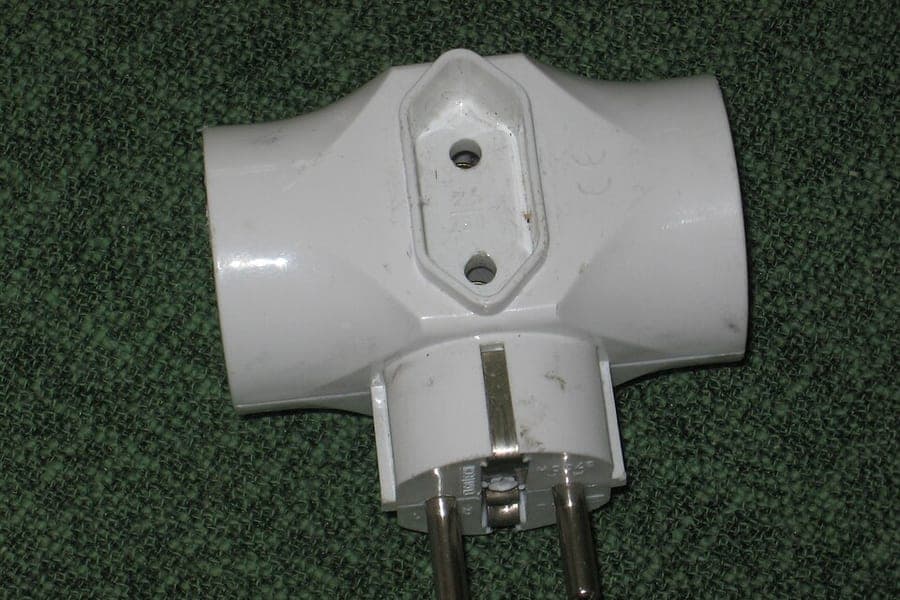
The distinction that matters
| Product | What it changes | Who needs it |
|---|---|---|
| Adapter | The physical shape of the plug | Almost everyone, almost always |
| Converter | The mains voltage, typically 220–240 V down to 110–120 V | Only single-voltage appliances — mostly heating elements |
The world runs on two rough voltage standards: around 110–120 V in North America and parts of Asia and South America, and around 220–240 V across Europe, Africa, most of Asia and Australasia. Plug shapes vary far more than that, which is why an adapter is the common need.
Read the label on the charger
The answer for any given device is printed on it, usually in tiny gray text on the plug body or the power brick. Find the line beginning “Input”.
| If the label says | What it means | What you need |
|---|---|---|
| Input: 100–240V ~50/60Hz | Dual voltage — it handles anything | An adapter only |
| Input: 120V ~60Hz | Single voltage, US only | A converter, or leave it at home |
| Input: 220–240V ~50Hz | Single voltage, non-US | A converter to use it in the US |
In practice essentially every phone charger, laptop charger, camera charger, tablet charger and electric toothbrush made this century is dual voltage. The devices that are not are the ones that turn electricity into heat.
The exception: anything that makes heat
- Hair dryers, straighteners and curling irons — the classic casualty. A single-voltage US dryer plugged into European mains through a plug-shape adapter receives double its design voltage and destroys itself, usually audibly.
- Travel kettles, irons and small heaters — same physics.
- Some electric shavers, though most are now dual voltage. Check.
The practical answer for all of these is not a converter. Converters that handle high-wattage heating appliances are heavy, and the appliance is usually available at the destination or provided by the accommodation. Leave it at home. What else is not worth carrying.
The wattage arithmetic on multi-port adapters
A universal adapter with several USB ports publishes a total output that is shared across all of them — not per port. It is the specification that decides whether the thing is useful.
| Adapter | Published weight | Published warranty | Notes |
|---|---|---|---|
| EPICKA TA-105C | 0.32 lb | 2 years | Flame-retardant polycarbonate, multi-standard plug |
| Ceptics World Adapter Kit (11-piece) | 1 lb | Lifetime limited | Grounded plugs rated to 13 A at up to 250 V |
The compact class shares roughly 30 W across its ports, which charges phones and tablets and will not meaningfully charge a laptop. A laptop wants 45 to 65 W to itself. The adapters compared on wattage.
Which produces the sensible kit: one adapter, and your own multi-port USB-C charger plugged into it. The adapter solves plug shape; your own charger delivers the wattage you already know works.
When you need a grounded adapter
Most compact universal adapters are two-pin and ungrounded. That is fine for phone and laptop chargers, which are double-insulated.
It is not fine for anything with a metal chassis and a three-pin plug — some laptop power bricks, camera equipment and any appliance drawing real current. The Ceptics kit publishes grounded plugs rated to 13 A at up to 250 V and weighs 1 lb for eleven pieces, which is three times the compact adapter for a problem most travelers do not have.
The kit that covers everything
- One universal adapter at about 0.32 lb.
- Your own multi-port USB-C charger, which you have already confirmed charges your laptop.
- Two cables and one spare. Cables fail more than anything else.
- A power bank for the flight and the gap between sockets. Which capacity.
- All of it in one pouch, in the bag that stays with you — because the bank is prohibited in the hold. The full checklist.
Every pick, with the working
Each entry below shows the published inputs, the four axis scores they produce, and what you give up. The order is the computed order, not a commercial one.
1 · High-draw devices and anyone who wants a grounded connection
Ceptics World Travel Adapter Kit (11-piece)
Eleven separate grounded plug adapters rather than one universal body — no electronics to fail, a lifetime warranty, and a published 13 A rating a folding adapter cannot match.
- Published size
- 2 × 1.75 × 1.75 in
- Weight
- 1 lb
- Capacity
- Not published
- Weight per liter
- Not published
- Cost per covered year
- Not published
- Published list price
- Not published
Warranty Lifetime limited warranty
Fits 11 of 11 US carriers: AA, DL, UA, WN, AS, B6, F9, G4, HA, MX, SY. See the limits.
What it does well
- Published 13 A at up to 250 V, far above what a folding universal adapter carries
- Grounded, which most compact universal adapters are not
- Lifetime limited warranty on a product with no electronics to fail
What you give up
- 16 oz for the full kit — the heaviest accessory in our ledger
- No USB ports at all: it is a plug adapter, not a charger
- Eleven pieces means ten of them are dead weight on any given trip
The arithmetic behind the score
- Value not scored — No manufacturer-published price, so this axis is not scored.
- Airline-fit breadth 10.0/10 — Fits the published carry-on limit at 11 of 11 US carriers: AA, DL, UA, WN, AS, B6, F9, G4, HA, MX, SY
- Carry efficiency not scored — No published capacity, so weight per liter cannot be computed.
- Warranty & support 6.0/10 — no stated end date (6 of 6); no published repair route (+0); airline damage not covered (+0)
Weights and breakpoints are published on how we rank. Where an input is not published, that axis is dropped and the remaining weights are re-normalized.
Specs: Ceptics published specifications, compiled 3 September 2026. Retail-channel pricing only. Check the live price before buying.
2 · Phone, tablet and headphone charging across plug standards
EPICKA TA-105C Universal Travel Adapter
30 W total across six ports is the number that matters: it is enough for a phone and a tablet at once, and not enough for a laptop.
- Published size
- 2.8 × 2.05 × 1.97 in
- Weight
- 0.32 lb
- Capacity
- Not published
- Weight per liter
- Not published
- Cost per covered year
- Not published
- Published list price
- Not published
Warranty 2 year limited warranty
Fits 11 of 11 US carriers: AA, DL, UA, WN, AS, B6, F9, G4, HA, MX, SY. See the limits.
What it does well
- Published 30 W total output across three USB-C and two USB-A ports plus an AC outlet
- Two spare 10 A fuses in the box, which tells you what fails
- 5.1 oz published, small enough to live in a personal item permanently
What you give up
- An adapter, not a converter — it changes the plug shape, never the voltage
- 30 W shared across six ports is a trickle if you fill them
- 2 year warranty is short for something carrying mains voltage
The arithmetic behind the score
- Value not scored — No manufacturer-published price, so this axis is not scored.
- Airline-fit breadth 10.0/10 — Fits the published carry-on limit at 11 of 11 US carriers: AA, DL, UA, WN, AS, B6, F9, G4, HA, MX, SY
- Carry efficiency not scored — No published capacity, so weight per liter cannot be computed.
- Warranty & support 0.5/10 — 2 yr (0.5 of 6); no published repair route (+0); airline damage not covered (+0)
Weights and breakpoints are published on how we rank. Where an input is not published, that axis is dropped and the remaining weights are re-normalized.
Specs: EPICKA published specifications, compiled 3 September 2026. Retail-only pricing. Check the live price before buying.
3 · A phone-and-tablet power bank that never raises a question at a gate
Anker PowerCore 10000 PD Redux
36.3 Wh is barely a third of the 100 Wh airline threshold, so it never needs approval — and at 6.8 oz it is the smallest thing on this site that will fully recharge a phone twice.
- Published size
- 4.17 × 2.05 × 0.98 in
- Weight
- 0.42 lb
- Capacity
- Not published
- Weight per liter
- Not published
- Cost per covered year
- Not published
- Published list price
- Not published
Warranty 18 month limited warranty with lifetime technical support
Fits 11 of 11 US carriers: AA, DL, UA, WN, AS, B6, F9, G4, HA, MX, SY. See the limits.
What it does well
- 36.3 Wh published, comfortably inside the 100 Wh limit airlines apply without approval
- 6.8 oz and 0.98 in thick — it disappears into a personal item
- USB-C carries both input and output, so one cable charges the bank and the phone
What you give up
- 18 months is the shortest published warranty of any product on this site
- 10,000 mAh is two phone charges, not a laptop
- No manufacturer-published price to compute cost per covered year
The arithmetic behind the score
- Value not scored — No manufacturer-published price, so this axis is not scored.
- Airline-fit breadth 10.0/10 — Fits the published carry-on limit at 11 of 11 US carriers: AA, DL, UA, WN, AS, B6, F9, G4, HA, MX, SY
- Carry efficiency not scored — No published capacity, so weight per liter cannot be computed.
- Warranty & support 0.5/10 — 1.5 yr (0.5 of 6); no published repair route (+0); airline damage not covered (+0)
Weights and breakpoints are published on how we rank. Where an input is not published, that axis is dropped and the remaining weights are re-normalized.
Specs: Anker published specifications, compiled 3 September 2026. Retail-channel pricing only. Check the live price before buying.
4 · Cables and chargers only, at the lowest possible weight
BAGSMART Travel Electronics Organizer
0.24 lb and 1.4 in thick, which is a fifth of the Peak Design's weight — it slides flat against the back panel of a bag where the Peak Design has to be packed around.
- Published size
- 9.4 × 6.7 × 1.4 in
- Weight
- 0.24 lb
- Capacity
- Not published
- Weight per liter
- Not published
- Cost per covered year
- Not published
- Published list price
- Not published
Warranty No warranty term published
Fits 11 of 11 US carriers: AA, DL, UA, WN, AS, B6, F9, G4, HA, MX, SY. See the limits.
What it does well
- 0.24 lb published — the lightest organizer we have compiled
- 1.4 in deep, so it lies flat rather than occupying a corner
- Elastic loops in two sizes, which is the layout that keeps cables from tangling
What you give up
- No published warranty term at all
- No published capacity, so cost per liter cannot be computed
- Flat layout means nothing thicker than a small plug fits well
The arithmetic behind the score
- Value not scored — No manufacturer-published price, so this axis is not scored.
- Airline-fit breadth 10.0/10 — Fits the published carry-on limit at 11 of 11 US carriers: AA, DL, UA, WN, AS, B6, F9, G4, HA, MX, SY
- Carry efficiency not scored — No published capacity, so weight per liter cannot be computed.
- Warranty & support 0.0/10 — no published term (0 of 6); no published repair route (+0); airline damage not covered (+0)
Weights and breakpoints are published on how we rank. Where an input is not published, that axis is dropped and the remaining weights are re-normalized.
Specs: BAGSMART published specifications, compiled 3 September 2026. Retail-channel pricing only. Check the live price before buying.
5 · Working trips where the laptop has to survive a delay
Anker 737 Power Bank (PowerCore 24K)
Skip this one. Skip it as a charging-abroad solution, which it is not. A published 1.39 lb power bank stores energy; it does not solve plug shape or voltage. Carrying one instead of an adapter means you have one day of power and then a dead bank and no way to fill it.
The only bank in this ledger that will actually charge a laptop, at a published 140 W — and at roughly 87 Wh it is the closest you can legally get to the 100 Wh cabin ceiling.
- Published size
- 6.13 × 2.15 × 1.95 in
- Weight
- 1.39 lb
- Capacity
- Not published
- Weight per liter
- Not published
- Cost per covered year
- Not published
- Published list price
- $109.99
Warranty No warranty term published on the product page
Fits 11 of 11 US carriers: AA, DL, UA, WN, AS, B6, F9, G4, HA, MX, SY. See the limits.
What it does well
- 140 W published output is enough for most laptops, where a 10,000 mAh bank is not
- 24,000 mAh is approximately 87 Wh — under the 100 Wh threshold, so no airline approval needed
- $109.99 published, which is a real number to judge value against
What you give up
- 1.39 lb is more than three times the weight of a 10,000 mAh bank
- Anker publishes no watt-hour figure on the page, so you compute the 87 Wh yourself
- No warranty term published on the product page
The arithmetic behind the score
- Value not scored — No published warranty term or capacity to divide the price by.
- Airline-fit breadth 10.0/10 — Fits the published carry-on limit at 11 of 11 US carriers: AA, DL, UA, WN, AS, B6, F9, G4, HA, MX, SY
- Carry efficiency not scored — No published capacity, so weight per liter cannot be computed.
- Warranty & support 0.0/10 — no published term (0 of 6); no published repair route (+0); airline damage not covered (+0)
Weights and breakpoints are published on how we rank. Where an input is not published, that axis is dropped and the remaining weights are re-normalized.
Specs: Anker published specifications and price, compiled 3 September 2026.
Prices last verified October 22, 2026. Prices move — the figure you see on Amazon at the moment you click is the real one.