TSA Rules for Batteries and Electronics
This is the one baggage rule that runs backwards: batteries are restricted in the hold and permitted in the cabin. Getting it wrong means losing the item at the door.
We have not tested this gear. Every figure here is compiled from published manufacturer specifications and published airline policies, and the arithmetic is public so you can check it. This page contains affiliate links — see the affiliate disclosure.
Spare lithium batteries and power banks must fly in the cabin — they are prohibited in checked baggage, including a carry-on that gets gate-checked at the door. Capacity is capped in watt-hours: under 100 Wh needs no approval, 100–160 Wh needs the airline’s approval, and over 160 Wh does not fly.
- Power banks and spare lithium batteries — cabin only
- E-cigarettes and vapes — cabin only, and not charged in flight
- Lighters and safety matches — cabin only, one on your person
- Smart luggage with a non-removable battery — often prohibited as checked baggage entirely
- Laptops, tablets, cameras — either, but the cabin is safer and faster at screening
This page summarizes published FAA and TSA guidance. Individual airlines may be stricter, and the checkpoint officer has the final say on any item. The authoritative sources are linked at the bottom of this page.
| # | Product | Published capacity | Fits | Score | Price |
|---|---|---|---|---|---|
| 1 | Anker PowerCore 10000 PD ReduxA phone-and-tablet power bank that never raises a question at a gate | 36.3 Wh lithium-ion, USB-C in/out plus USB-A | 11 of 11AA DL UA WN … | 5.8 | Check price on Amazon#ad How we earn |
| 2 | INIU B41 Slim 10000mAh Power BankBuyers who want the longest published warranty on a power bank | Approximately 37 Wh lithium-ion, USB-C in/out | Not published | 1.5 | $54.99 · Check on Amazon#ad How we earn |
Prices last verified October 19, 2026. Prices move — the figure you see on Amazon at the moment you click is the real one.
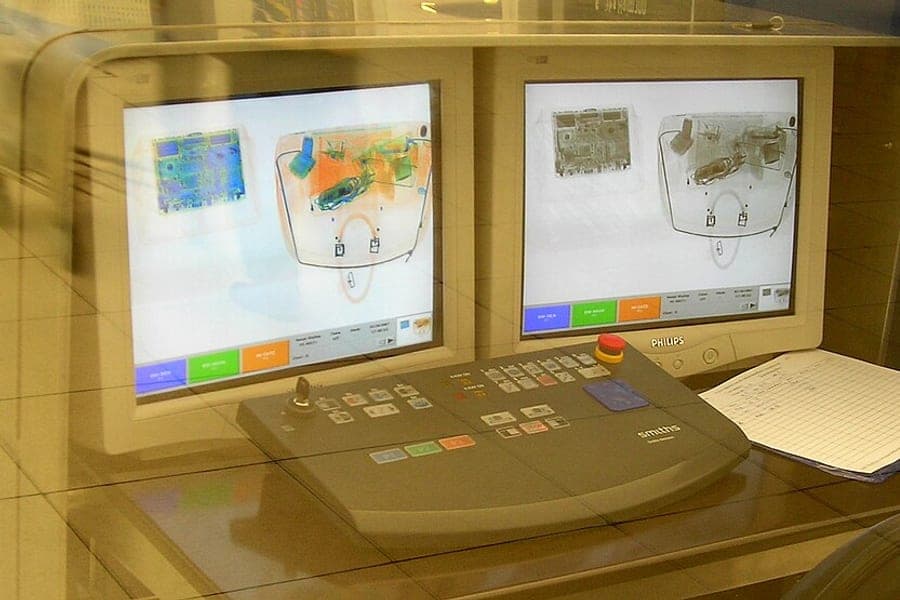
Why this rule runs backwards
Almost every baggage restriction exists because an item could be dangerous in the cabin — a knife, a firearm, a large volume of liquid. Battery rules exist for the opposite reason: a lithium cell in thermal runaway is dangerous anywhere, and the cabin is the only place a crew can see it start and put it out.
In the hold, nobody knows until there is smoke. That is the entire logic, and once you have it, every item on the cabin-only list above makes immediate sense.
Watt-hours, and the conversion nobody does
Airlines write the rule in watt-hours. Every product on the shelf advertises milliamp-hours. The two are not interchangeable and the conversion is not printed on the box unless the manufacturer chose to print it.
A well-made power bank prints its Wh figure on the case. Anker publishes 36.3 Wh for the PowerCore 10000 PD Redux, which is exactly what the formula gives. If a bank displays no Wh figure at all, you have no way to demonstrate compliance if asked — and that is a real reason to prefer a brand that publishes one. Both banks we track and their published figures.
The three thresholds in full
| Watt-hours | Checked | Carry-on | Quantity |
|---|---|---|---|
| Under 100 Wh | Prohibited as a spare | Allowed, no approval | Typically up to two spares per passenger |
| 100–160 Wh | Prohibited as a spare | Allowed with airline approval | Usually a maximum of two |
| Over 160 Wh | Prohibited | Prohibited | Not carried on passenger aircraft |
Note the distinction between a battery installed in a device and a spare. A laptop with its battery inside is a device; a power bank is a spare, because its entire purpose is to be a battery. Spares are the restricted category.
The gate-check trap
This is where people actually get caught, and it has become more common as bins fill earlier. You board with a compliant carry-on, the bins are full, and the agent takes your bag at the door. Your power bank is now in the hold, which is exactly where it may not be.
Nobody screens a gate-checked bag for this. The rule is not enforced at that moment — which means the responsibility, and the fire risk, is yours. The fix is a habit rather than a product:
- Keep every battery, cable and charger in one pouch, in the bag that stays with you. That is what a cable organizer is genuinely for.
- If you are gate-checking, pull that pouch out before you hand the bag over. It takes five seconds because everything is in one object.
- The full gate-check guide covers what else should come out at the same moment.
Smart luggage
Suitcases with integrated batteries are permitted as carry-on where the battery can be removed, and are widely prohibited as checked baggage where it cannot. If you own one, know how the battery comes out before you are standing at a gate being asked to demonstrate it.
None of the cases in our carry-on ledger has an integrated battery, which is one fewer thing to explain at a door.
At the checkpoint
- Laptops usually come out of the bag into their own tray, unless the checkpoint has a CT scanner. Pack the laptop where you can reach it without unpacking the bag.
- Tablets and e-readers are frequently treated the same way at US checkpoints. Smaller devices normally stay in.
- Power banks stay in the bag in most cases, but are a common cause of a secondary bag search because they look dense on the X-ray. Keeping them in one pouch makes that search fast.
- PreCheck and equivalents generally let electronics stay in the bag entirely, which is the main practical benefit of the program for a gear-heavy traveler.
Outside the US
The 100 Wh and 160 Wh thresholds come from ICAO and are effectively universal — you will find the same two numbers in the baggage policy of every carrier on our carrier table. What varies is the number of spares permitted and how strictly the approval step for the 100–160 Wh band is applied.
A few carriers additionally require spare batteries to be individually protected against short circuit — in the original packaging, a dedicated case, or with the terminals taped. That is good practice regardless of whether your airline demands it, and it costs nothing.
Every pick, with the working
Each entry below shows the published inputs, the four axis scores they produce, and what you give up. The order is the computed order, not a commercial one.
1 · A phone-and-tablet power bank that never raises a question at a gate
Anker PowerCore 10000 PD Redux
36.3 Wh is barely a third of the 100 Wh airline threshold, so it never needs approval — and at 6.8 oz it is the smallest thing on this site that will fully recharge a phone twice.
- Published size
- 4.17 × 2.05 × 0.98 in
- Weight
- 0.42 lb
- Capacity
- Not published
- Weight per liter
- Not published
- Cost per covered year
- Not published
- Published list price
- Not published
Warranty 18 month limited warranty with lifetime technical support
Fits 11 of 11 US carriers: AA, DL, UA, WN, AS, B6, F9, G4, HA, MX, SY. See the limits.
What it does well
- 36.3 Wh published, comfortably inside the 100 Wh limit airlines apply without approval
- 6.8 oz and 0.98 in thick — it disappears into a personal item
- USB-C carries both input and output, so one cable charges the bank and the phone
What you give up
- 18 months is the shortest published warranty of any product on this site
- 10,000 mAh is two phone charges, not a laptop
- No manufacturer-published price to compute cost per covered year
The arithmetic behind the score
- Value not scored — No manufacturer-published price, so this axis is not scored.
- Airline-fit breadth 10.0/10 — Fits the published carry-on limit at 11 of 11 US carriers: AA, DL, UA, WN, AS, B6, F9, G4, HA, MX, SY
- Carry efficiency not scored — No published capacity, so weight per liter cannot be computed.
- Warranty & support 0.5/10 — 1.5 yr (0.5 of 6); no published repair route (+0); airline damage not covered (+0)
Weights and breakpoints are published on how we rank. Where an input is not published, that axis is dropped and the remaining weights are re-normalized.
Specs: Anker published specifications, compiled 3 September 2026. Retail-channel pricing only. Check the live price before buying.
2 · Buyers who want the longest published warranty on a power bank
INIU B41 Slim 10000mAh Power Bank
Twice the warranty of anything else in this category at roughly the same capacity — three years against Anker's eighteen months, on a product whose failure mode is the battery degrading.
- Published size
- Not published
- Weight
- Not published
- Capacity
- Not published
- Weight per liter
- Not published
- Cost per covered year
- Not published
- Published list price
- Not published
Warranty 3 year INIU Care warranty with lifetime technical support
Fits No published dimensions to check.
What it does well
- 3 year published warranty is double Anker's on a comparable bank
- Roughly 37 Wh, well inside the 100 Wh threshold airlines apply without approval
- 0.5 in published thickness — one of the slimmest 10,000 mAh bodies sold
What you give up
- INIU publishes no full dimensions and no weight, so two of our axes cannot be scored
- 15 W output is slower than the fast-charging banks in the same size class
- No manufacturer-published price
The arithmetic behind the score
- Value not scored — No manufacturer-published price, so this axis is not scored.
- Airline-fit breadth not scored — No published dimensions to check against carrier limits.
- Carry efficiency not scored — No published capacity, so weight per liter cannot be computed.
- Warranty & support 1.5/10 — 3 yr (1.5 of 6); no published repair route (+0); airline damage not covered (+0)
Weights and breakpoints are published on how we rank. Where an input is not published, that axis is dropped and the remaining weights are re-normalized.
Specs: INIU published specifications, compiled 3 September 2026. INIU publishes a 0.5 in thickness and describes the body as slimmer than comparable 10,000 mAh banks, but no full three-dimensional figure we could read. Retail-channel pricing only. Check the live price before buying.
Prices last verified October 19, 2026. Prices move — the figure you see on Amazon at the moment you click is the real one.