The Best Travel Power Strip
One specification decides this purchase, and it is not the outlet count. Whether the strip has surge protection determines whether it is allowed aboard a ship at all — and the two cruise lines that publish a rule publish opposite rules.
We have not tested this gear. Every figure here is compiled from published manufacturer specifications and published airline policies, and the arithmetic is public so you can check it. This page contains affiliate links — see the affiliate disclosure.
Check whether it has surge protection before you check anything else. Carnival’s published policy allows “extension cords without surge protection”; Royal Caribbean prohibits “extension cords, power strips, multi-plug outlets” outright. For a hotel abroad the decision is different again: a US strip changes nothing about voltage, so 230 V reaches whatever you plug in.
Manufacturer-published listing specifications and the cruise lines’ own published policies, compiled 6 October 2026. We have not tested any of this equipment.
| # | Product | Published weight | Fits | Score | Price |
|---|---|---|---|---|---|
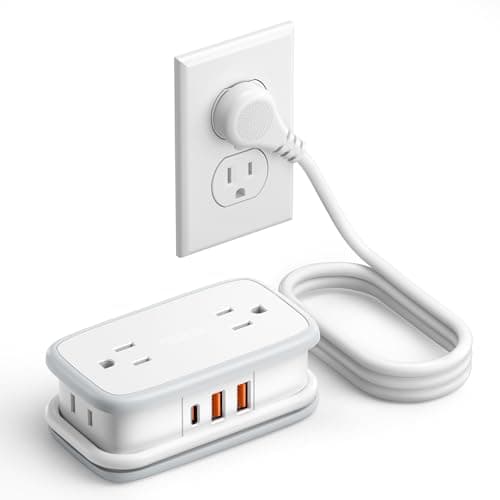
| 1 | NTONPOWER 20W Travel Power Strip (4 outlets, 3 USB)A hotel or cabin where the problem is outlet count, not wattage | 0.5 lb | 11 of 11AA DL UA WN … | 5.8 | $14.39 · Check on Amazon#ad How we earn |
| 2 | Anker Nano Charging Station (6-in-1, 67W)A hotel desk with one outlet and a laptop, a phone and a watch to charge | 0.87 lb | 11 of 11AA DL UA WN … | 5.8 | $33.99 · Check on Amazon#ad How we earn |
| 3 | Ceptics Travel Power Strip with International Plug SetA trip crossing more than one plug standard, where you want US sockets at the far end | 0.31 lb | 11 of 11AA DL UA WN … | 5.8 | $27.99 · Check on Amazon#ad How we earn |
Prices last verified October 7, 2026. Prices move — the figure you see on Amazon at the moment you click is the real one.
The three, as published
| Strip | AC outlets | USB | Surge protection | Rated voltage | Published weight |
|---|---|---|---|---|---|
| NTONPOWER 20W Travel | 4 | 3 (20 W PD) | None — published as the selling point | 125 V | 8 oz |
| Anker Nano Charging Station (6-in-1) | 2 | 4 (67 W shared) | None — stated in the listing | 125–240 V (USB ports) | 13.92 oz |
| Ceptics Travel Power Strip | 2 grounded | 2 | Yes — built in | 110 V | 5 oz |
The cruise rule, from three lines’ own pages
“Cruise approved power strip” is a marketing phrase printed on listings, not a certification anybody issues. So we read what the lines publish. They do not agree, and one of them does not address it at all.
| Line | Power strips and extension cords | Irons and garment steamers |
|---|---|---|
| Carnival | Published as allowed: “power strips”, “multi-outlet adapters” and “extension cords without surge protection” | Prohibited — both named |
| Royal Caribbean | Prohibited: “extension cords, power strips, multi-plug outlets”. Device and USB chargers with a recognized US or European conformity mark are permitted | Prohibited — both named |
| Norwegian | Not named anywhere on its published prohibited-items list | Prohibited as a heating element, alongside kettles and coffee machines |
Why a ship cares about surge protection at all
A surge protector works by diverting excess voltage to ground. Ships run electrical systems that are not grounded the way a building’s is, and the published reasoning from the lines that ban them is fire risk on a circuit that cannot absorb the fault. Whether you accept the engineering, the practical consequence is the same: at the terminal, a bag scan that finds a surge protector on Royal Caribbean loses you the device.
On land the trade reverses. A hotel circuit you know nothing about is exactly where surge protection earns its keep, and the Ceptics is the only one of the three that publishes any.
The voltage trap, which is the real reason people buy the wrong one
A power strip does not change voltage. Nothing on this page is a converter, and the Ceptics listing says so in capital letters. Plug a 125 V-rated strip into a 230 V European socket through a plug adapter and you have delivered 230 V to the strip and to everything in it.
- The NTONPOWER is rated 125 V. It is a US-voltage device. It belongs in a US hotel, a US cabin or a cruise ship stateroom, which run US voltage.
- The Anker is split. Its listing publishes 125–240 V input on the USB ports — the half of the device that travels — while the two AC outlets pass mains voltage through unchanged.
- The Ceptics is rated 110 V and ships with Type A, C, E/F, G and I plug adapters. The adapters change the shape of the plug; the strip still presents US sockets at 110 V rating.
The practical rule, which is the same rule as on charging devices abroad: read the brick on your own device. Anything marked 100–240 V is fine anywhere. Anything marked 120 V only — which is most hair dryers and some older appliances — is not made safe by any strip, adapter or plug on this page.
The Anker argument: a strip that is also the charger
The Anker is the heaviest here at a published 13.92 oz, and the only one that makes the weight back. It publishes 67 W shared across two USB-C ports, which is laptop charging, so it replaces both the power strip and the charging brick rather than adding to the pile.
Weigh it against what you would otherwise carry. The chargers in our ledger run 65–70 W in that bracket. If the Anker replaces one of those, the strip itself costs you a few ounces net, not 14.
If the problem is outlet count, buy on outlet count
Hotel rooms are built for lamps, not for a family with five devices. The NTONPOWER publishes four AC outlets and three USB ports in a 3.93 × 2.28 × 1.25 in body at 8 oz, with a 0.39 in flat plug and a wrap-around cord. That is twice the AC outlets of either rival in less than two thirds of the Anker’s weight, and it is the right answer whenever you are not short of watts.
What it will not do is charge a laptop. 20 W on one USB-C port is a phone, a watch and a pair of earbuds.
Can you take a power strip on a plane?
Yes, in either bag. A power strip contains no lithium cell, so none of the battery rules apply to it — those are covered on the TSA battery and electronics page. A power bank is the opposite case and must travel in the cabin. The only practical air-travel cost of a strip is the weight above, and on Hawaiian’s published 25 lb cap the Anker is about 3.5 percent of your whole allowance.
Every pick, with the working
Each entry below shows the published inputs, the four axis scores they produce, and what you give up. The order is the computed order, not a commercial one.
1 · A hotel or cabin where the problem is outlet count, not wattage
NTONPOWER 20W Travel Power Strip (4 outlets, 3 USB)
Four outlets and three USB ports at 0.5 lb, and the only strip here whose absence of surge protection is the selling point rather than a footnote. Read the cruise section before you believe the label.
- Published size
- 3.93 × 2.28 × 1.25 in
- Weight
- 0.5 lb
- Capacity
- Not published
- Weight per liter
- Not published
- Cost per covered year
- Not published
- Published list price
- Not published
Warranty 18 month warranty published in the listing
Fits 11 of 11 US carriers: AA, DL, UA, WN, AS, B6, F9, G4, HA, MX, SY. See the limits.
What it does well
- 4 AC outlets plus 3 USB in 3.93 x 2.28 x 1.25 in and a published 0.5 lb
- No surge protection, which is exactly what Carnival's published policy allows aboard
- 0.39 in flat plug and a wrap-around cord, so it packs flat against a laptop
What you give up
- Rated 125 V — this is a US-voltage strip and does not belong in a 230 V socket
- 20 W on one USB-C port will not charge a laptop; this is a phone-and-watch device
- The cruise-approved claim is true on Carnival and false on Royal Caribbean, which bans power strips outright
The arithmetic behind the score
- Value not scored — No manufacturer-published price, so this axis is not scored.
- Airline-fit breadth 10.0/10 — Fits the published carry-on limit at 11 of 11 US carriers: AA, DL, UA, WN, AS, B6, F9, G4, HA, MX, SY
- Carry efficiency not scored — No published capacity, so weight per liter cannot be computed.
- Warranty & support 0.5/10 — 1.5 yr (0.5 of 6); no published repair route (+0); airline damage not covered (+0)
Weights and breakpoints are published on how we rank. Where an input is not published, that axis is dropped and the remaining weights are re-normalized.
Specs: NTONPOWER published listing specifications, compiled 3 September 2026. Retail-channel pricing only. Check the live price before buying.
2 · A hotel desk with one outlet and a laptop, a phone and a watch to charge
Anker Nano Charging Station (6-in-1, 67W)
The only strip here that is also a 67 W laptop charger, which is the whole argument for it: one device replaces the strip and the brick. It publishes no surge protection, which on one of the three cruise lines we checked is exactly why it is allowed aboard.
- Published size
- 3.94 × 3.66 × 0.75 in
- Weight
- 0.87 lb
- Capacity
- Not published
- Weight per liter
- Not published
- Cost per covered year
- Not published
- Published list price
- Not published
Warranty 24 month product warranty published in the listing text
Fits 11 of 11 US carriers: AA, DL, UA, WN, AS, B6, F9, G4, HA, MX, SY. See the limits.
What it does well
- 67 W published across 2 USB-C ports — enough to charge a laptop, which no other strip here claims
- 0.87 lb and 3.94 x 3.66 x 0.75 in, so it replaces a power strip and a charger rather than adding to them
- The listing publishes 125-240 V input on the USB ports, which is the half of the device that travels
What you give up
- The AC outlets pass mains voltage through unchanged — this is not a converter, and 230 V reaches a US appliance
- Warranty figures disagree inside one listing: the text says 24 months, the specification table says 18
- No surge protection, which is a liability on a hotel circuit even though it is what makes it cruise-legal on Carnival
The arithmetic behind the score
- Value not scored — No manufacturer-published price, so this axis is not scored.
- Airline-fit breadth 10.0/10 — Fits the published carry-on limit at 11 of 11 US carriers: AA, DL, UA, WN, AS, B6, F9, G4, HA, MX, SY
- Carry efficiency not scored — No published capacity, so weight per liter cannot be computed.
- Warranty & support 0.5/10 — 2 yr (0.5 of 6); no published repair route (+0); airline damage not covered (+0)
Weights and breakpoints are published on how we rank. Where an input is not published, that axis is dropped and the remaining weights are re-normalized.
Specs: Anker published listing specifications, compiled 3 September 2026. Retail-channel pricing only. Check the live price before buying.
3 · A trip crossing more than one plug standard, where you want US sockets at the far end
Ceptics Travel Power Strip with International Plug Set
Skip this one. Skip it for a cruise. It is the best of the three for a trip abroad — grounded US sockets plus the five plug shapes a single European itinerary can cross — but it is the only one here that publishes surge protection, and surge protection is the exact feature both cruise lines that name power strips prohibit. One listing also publishes two different outside sizes for it, which is a small warning about how carefully the rest of its data was compiled.
The one here built for abroad: grounded US sockets plus the five plug shapes a single trip can cross, and the only one of the three that publishes surge protection. That last fact is also what gets it confiscated on a cruise.
- Published size
- 3.75 × 2.5 × 1 in
- Weight
- 0.31 lb
- Capacity
- Not published
- Weight per liter
- Not published
- Cost per covered year
- Not published
- Published list price
- Not published
Warranty 2 year warranty published in the listing
Fits 11 of 11 US carriers: AA, DL, UA, WN, AS, B6, F9, G4, HA, MX, SY. See the limits.
What it does well
- Includes Type A, C, E/F, G and I plug adapters — the five shapes that cover Europe, the UK, Japan and Australia
- Published surge protection, which neither other strip here offers
- 0.31 lb is the lightest of the three and it ships with its own pouch
What you give up
- Surge protection makes it prohibited on both cruise lines whose published policies name power strips
- Rated 110 V and explicitly not a converter — your 120 V-only hair dryer still will not work
- One listing publishes two different outside sizes, which is a small warning about the rest of the data
The arithmetic behind the score
- Value not scored — No manufacturer-published price, so this axis is not scored.
- Airline-fit breadth 10.0/10 — Fits the published carry-on limit at 11 of 11 US carriers: AA, DL, UA, WN, AS, B6, F9, G4, HA, MX, SY
- Carry efficiency not scored — No published capacity, so weight per liter cannot be computed.
- Warranty & support 0.5/10 — 2 yr (0.5 of 6); no published repair route (+0); airline damage not covered (+0)
Weights and breakpoints are published on how we rank. Where an input is not published, that axis is dropped and the remaining weights are re-normalized.
Specs: Ceptics published listing specifications, compiled 3 September 2026. The listing publishes two different sizes for one product: 2.5 x 1 x 3.75 in in the specification table and 5.35 x 2.00 x 1 in in the description. We score the table figure and print both. Retail-channel pricing only. Check the live price before buying.
Prices last verified October 7, 2026. Prices move — the figure you see on Amazon at the moment you click is the real one.
Common questions
What is the best travel power strip?
Are power strips allowed on cruise ships?
Why are surge protectors banned on cruise ships?
Can you use a US power strip in Europe?
Can you bring a power strip on a plane?
Do I need surge protection in a hotel?
Sources
- Carnival — published prohibited and allowed items
- Royal Caribbean — published prohibited items onboard policy
- Norwegian Cruise Line — published list of what cannot come onboard
- Anker — Nano Charging Station published listing specifications
- NTONPOWER — 20W Travel Power Strip published listing specifications
- Ceptics — Travel Power Strip published listing specifications